 EAA Chapter 430
178 Seconds to Live: VFR into IMC
Open the PDF at page 4 See the whole January 2017 issue
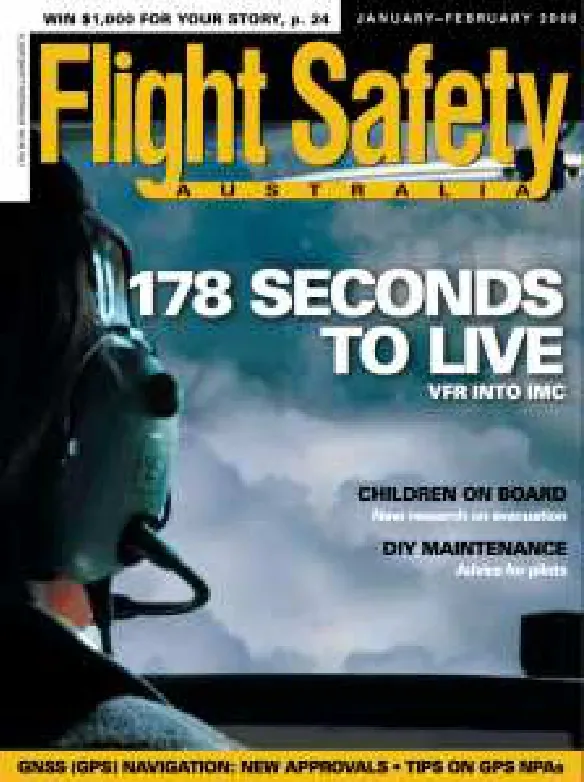 (opens a larger view)
from FlightSafety Australia January 22, 2016 Flights operating under visual flight rules (VFR) flying into instrument meteorological conditions (IMC) remains a prominent safety issue, with the Australian Transport Safety Bureau recording 111 occurrences over the last 10 years, investigating 18 serious incidents and accidents.
A decade after publishing 178 seconds to live, we look back at our cover story from 2006 and the safety advice still relevant today.
It’s an all too common scenario: a VFR pilot flies into IMC and needs help.
On average, Australian air traffic controllers are called upon once every 10 days to assist a pilot in deteriorating weather. Of the reported occurrences, 60 per cent are above cloud and can’t get down. The remainder are either in deteriorating weather, in cloud or have reduced visibility due to smoke or haze.
It is a dangerous situation. American research shows that 76 per cent of VFR into IMC accidents involve a fatality. The dangers of flying VFR into IMC have been recognized for a long time. Yet VFR pilots still fly into deteriorating weather and IMC.
Some of these pilots may simply underestimate the danger and overestimate their ability to cope with flight in reduced visibility. The pilots of the 24 fatal aircraft accidents involving continued flight into IMC in Australia over the 10 years from 1992 to 2002 probably thought the same thing. Fifty-four lives were lost in these accidents.
At some stage in your flying you will encounter bad weather—unless you only fly on perfect weather days.
Spatial disorientation is the big danger. And it can happen a lot faster than you might think— just 178 seconds on average, about the length of a commercial on TV. That estimate is based on studies in the 1990s by aviation researchers at the University of Illinois. They took 20 VFR pilots and got them to fly into IMC in specially programmed flight simulators.
All of the pilots in the study went into graveyard spirals that would have ended in uncontrolled flight into terrain or rollercoaster-like oscillations that became so intense that they would have resulted in structural failure of the aircraft.
In repeated tests on the simulator the result was the same—all pilots lost control of the aircraft. The outcome differed only in the time required before control was lost which ranged from just 20 seconds to 480 seconds.
A close look at one VFR into IMC incident illustrates the dangers.
In 1999, a pilot was conducting a visual flight rules (VFR) flight from Walgett to an airstrip near Merriwa. The Piper Archer had departed from Walgett earlier in the day, but returned a short time later when it was reported that weather at the destination was not suitable for VFR flight.
However, the pilot felt under pressure to complete the flight that day. He continued to monitor the weather by telephoning for weather reports from an automatic Bureau of Meteorology outlet and by contacting a friend near the destination airfield.
The aircraft departed again at 1415. But the pilot never reached Merriwa. The aircraft’s wreckage was located two days later on top of a ridge, 3880 ft above mean sea level (AMSL) slightly to the left of the direct track between Walgett and Merriwa.
The Australian Transport Safety Board (ATSB) investigation found that the Piper Archer collided with trees during a right turn, at a rate of descent of about 2500 ft/min.
A post impact fire consumed the cabin and fuselage immediately behind the cabin. The pilot and passenger escaped the wreckage; however, the pilot died from his injuries before rescuers could get to the accident site.
The pilot held a private pilot license for airplanes and a commercial helicopter license, together with a valid medical certificate. He did not hold an instrument rating and the aircraft was not approved for IMC.
Reports at the time of the accident indicated that the cloud base was 3600 ft AMSL, and that cloud was covering the ridge where the wreckage was found. The weather over lower terrain to the southwest of the accident site was suitable for VFR flight.
Once the aircraft entered cloud, the pilot was no longer able to rely on external visual references, and most likely became spatially disoriented.
Investigators noted that the pressure the pilot felt to complete the flight might have influenced him into choosing the shortest direct route over high terrain, with associated poor visibility, rather than the longer route further to the southwest, where clearer conditions prevailed.
Decisions, decisions
Just how different decision-making patterns affect safety was the subject of a recent ATSB report.
Three weather-related decision-making behaviors were compared: VFR pilots flying into IMC; a weather-related precautionary landing; and significant weather avoidance action.
The results suggest that the mid-point of the flight can be a ‘psychological turning point’ for pilots, regardless of the flight distance involved.
The VFR into IMC group had the greatest risk of a fatality or serious injury, while the ‘precautionary landing’ group had the greatest risk of some form of aircraft damage.
The chance of a VFR into IMC encounter increased as the flight progressed, until it reached a peak during the final 20 per cent of the flight distance. The results highlight the danger of pilots ‘pressing on’ to reach their destination.
A VFR pilot may exhibit a range of behaviors when faced with adverse weather. For example, at the first hint that conditions are deteriorating, a pilot may decide to immediately return to the point of departure.
At the other extreme, a pilot may ‘press on’ into deteriorating weather, either unable or unwilling to see the increasing danger of their actions, until the aircraft suddenly enters IMC.
A more typical scenario might involve a pilot who, in response to deteriorating conditions, initially continues the flight as planned, but later decides to return, divert, or perhaps even carry out a precautionary landing.
Chance can play a big part in the outcome as the following two accident case histories illustrate:
In case 1, the aircraft was on a private flight from Shepparton to Moorabbin with the pilot and three passengers on board. Before departing from Shepparton, the pilot had obtained an enroute weather forecast that indicated that VFR flight via the Kilmore gap was possible but that conditions were likely to be marginal.
On departure from Shepparton, there was scattered cloud at 2500 ft with a ceiling of approximately 4000 ft. Visibility was about eight km, with occasional rain showers.
As the flight approached Mangalore, the hills to the east and southwest were shrouded in low stratus. Abeam Seymour, the weather ahead appeared to be closing in so the pilot began a left turn onto a reciprocal heading for Mangalore.
However, the weather had closed in from behind, and soon after completing the turn the aircraft was enveloped in cloud. The pilot contacted Melbourne ATC and reported that he was in cloud with nil visibility. ATC advised him to concentrate on keeping the wings level, and provided radar vectors to ensure that the aircraft remained clear of high terrain in the vicinity.
Abeam Mangalore the aircraft broke free of cloud and the pilot was able to resume navigation. The flight continued to Shepparton and a safe landing.
This pilot emerged unscathed from a VFR into IMC incident because—luckily—advice and guidance were at hand.
In contrast, the pilot involved in the next accident, while initially slow to recognize deteriorating weather, made a wise decision to carry out a precautionary landing.
In spite of this, the aircraft was destroyed and the pilot and one of his passengers were injured.
The planned flight was from Bendigo to Albury. The area forecast indicated that the weather enroute would be okay for VFR flight. A cold front was moving slowly through the region from the southwest, but was not forecast to reach the area of the planned route until after the flight. The pilot did not hold an instrument rating but had completed three hours of instrument flight training.
The aircraft departed Bendigo at 11 am with the pilot, his wife, and their two children on board. It soon became clear that the front was moving much more quickly than forecast and that the weather along the planned route could deteriorate below that required for VFR flight. The pilot decided to return to Bendigo and told ATC of his intentions.
A short time later the pilot again contacted ATC and advised that the weather had deteriorated further and that he was going to carry out a precautionary landing in the Rushworth area.
The pilot identified a suitable landing area and carried out a low speed pass to confirm the area was free of obstacles. He configured the aircraft for a precautionary landing and made a slow-speed approach to the field.
Just after touchdown the nose gear hit the bank of a ditch that was hidden by reeds and long grass. The nose gear was sheared off, and the aircraft continued for some distance before it overturned and came to rest.
The pilot and the front-seat passenger were restrained by their lap-sash seat belts, but the pilot suffered a fracture to his left arm. One of the passengers in the rear of the aircraft received minor injuries.
What happens when you enter cloud?
Our normal environment is with two feet planted firmly on the earth, clear vision of our surroundings, gravity allowing us to feel weight/pressure on our feet (with a force of 1 g), and our inner ears providing our sense of balance.
Orientation is achieved with 80 per cent of the input to your brain coming from your eyes (external visual references) and 20 per cent split between your inner ear and proprioceptive system (seat of the pants or what you feel).
When you are flying you are operating in an unnatural environment that can result in different forces.
Usually it is easy to orient yourself in VFR flight. You have visual reference to a horizon outside the aircraft, and in steady flight you only have a force of 1 g acting on you. Even pulling 2 g in a steep turn is usually not a problem as long as you can see a horizon to maintain orientation.
But when a VFR pilot enters cloud, the horizon disappears. Suddenly, 80 per cent of the input you need for orientation is lost. Worse, if your flight attitude changes, or you make any maneuver that results in forces of more than 1 g, your sense of balance will also change.
Spatial illusions and disorientation are created when the fluid of the inner ear responds to acceleration, deceleration, pitch, roll and yaw. It is very easy to find yourself in a gradual turn once you have lost the horizon. Your inner ears will simply not detect the change.
Even after a minor distraction in the cockpit, you can find that when you look back at the artificial horizon that there has been a slow, 10 or 15-degree bank angle introduced. You make control inputs to correct the turn. But without a view of the horizon you will be relying on your sense of balance provided by your inner ears. The problem is that the acceleration forces affect the fluids in your inner ears resulting in a sensation of turning in the opposite direction.
To overcome this illusion you might make a correction back to the original position. While this may feel better to you, the original turn has been reintroduced with the airspeed increasing and the altimeter unwinding rapidly.
The illusions can be so strong that many pilots will disregard their instruments, certain that they’re wrong.
There is a simple way to demonstrate what it feels like to experience a slight disorientation or dizziness similar to the illusions that may happen in a cockpit in cloud. Sit on a swivel once chair and tuck you feet under the seat of the chair. Close your eyes and place your head forward so your chin touches your chest. Hold onto the seat so you don’t fall off and get someone to spin you around on the chair for 3 or 4 rotations (it doesn’t have to be very fast).
Then lift your head up straight and open your eyes. You will feel a slight dizziness as the movement of the fluid in the inner ear was moved into another rotational plane when you moved your head. This is different to what your eyes were telling you.
If you are VFR and you find yourself in IMC you need to ignore your senses, and follow your instruments. Seek help from ATC if you can. And try to remain calm.
Some general principles of instrument flying need to be understood and followed:
-
Trust the instruments and believe what they are telling you.
-
Maintain a scan of the instruments.
-
Do not dwell on one instrument for too long, and check the attitude indicator after you check any other instrument.
-
Use smooth and gentle control inputs to get the aircraft to do what you want.
One of the keys to avoiding a VFR into IMC incident is to be able to recognize deterioration in the weather while there is still time to make a safe diversion. This is often easier said than done, but there is evidence that in-flight, weather-related decision-making can be practiced and learned.
Research by the US Federal Aviation Administration has found that experienced pilots generally use the following indicators to assess in-flight weather changes:
-
Lowering cloud base.
-
Rising terrain.
-
Darkening clouds.
-
Increasing cloud cover.
-
Reducing visibility.
-
Rain showers.
-
Changes in wind direction and speed.
A change in three or more indicators was sufficient for the experienced pilot to initiate a diversion to an alternate or a return to the departure aerodrome.
You should monitor the weather behind your aircraft. There is no point deciding to turn back to find that the weather behind the aircraft is as bad as it is in front—or worse.
Always give yourself time to make informed decisions. If the weather appears to be getting worse, slow the aircraft down (use flaps and lower the gear). The slower speed will usually improve your forward visibility and give you more decision making time. It will also reduce your turning radius if you have to maneuver in a tight space.
The safest thing to do is to cancel a flight if the conditions look like they might become marginal. But it can be a difficult decision because you might have a lot of time and effort invested in the flight, and there may be friends and family counting on you.
Remember, your primary responsibility is your safety and the safety of your passengers.
Preparation: The key, of course, is to avoid deteriorating weather or IMC in the planning phase. Thorough weather planning and an extensive understanding of weather forecasts and meteorological conditions help pilots determine whether the weather is acceptable for VFR flight.
The weather on the TV usually gives a satellite image and a surface chart. Get to know what they mean and use them to check the weather around you even when not flying to give you an indication of how frontal passages and cloud bands evolve.
However, when you do commit to going flying make sure you get the relevant aviation forecasts you need and update them through FLIGHTWATCH.
You can also call ahead to your destination to find out actual weather or check with ATC to hear from pilots flying along the route.
When you are planning to take others on a private flight, make sure they understand the importance of the weather conditions, and tell them that you will cancel plans if the weather is not suitable. If someone has to be home by a certain time, make sure they understand this might not be possible.
Preparation is the key. Have the current maps and charts to ensure you have the latest information about airports, NAVAIDS and facilities available, including ATC frequencies.
Learn how to obtain weather and NOTAM information, and always submit a flight plan. Use ATC flight following services enroute. Call FLIGHTWATCH for updates of weather reports. And remember to always set the altimeter within 100 nm of the position of your aircraft to ensure you are flying an accurate height.
It all comes down to thorough preparation, alternate plans and timely decision-making. And decisions have to be constantly reassessed based on the current situation—looking and planning ahead is essential. Problems occur when pilots fail to make a decision. It’s vital that you constantly consider your options and that you are prepared to act swiftly.
Think could I get through there—have I got an escape route? It’s okay to turn around. It’s okay to consider that I won’t make my destination.
It comes down to thorough preparation, a range of alternate plans and timely decision-making.