 EAA Chapter 430
A Little Hangar Flying: Getting There Is Half the Fun and New Runways
Open the PDF at page 1 See the whole March 2017 issue
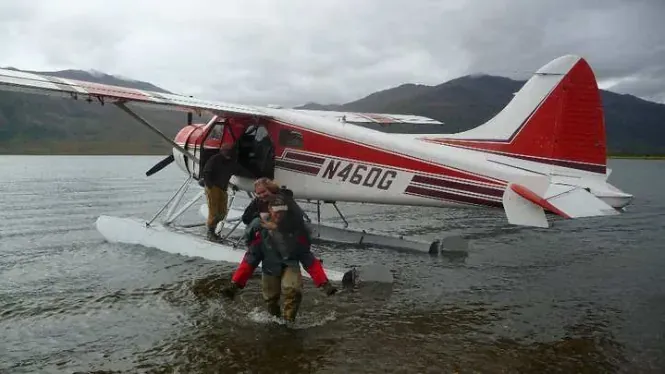
Getting there is half the Fun!
Here is my First Landing in the Skewentna Canyon “Cable” Crossing. Cable???? Where’s the cable??? One way in, One way out!!! Land up river, takeoff downriver.
This place is a special checkout. (I didn’t get a check out. I checked myself out). Note: I was authorized to go anywhere in the State. Not for the faint of heart as one new pilot exclaimed! The water is moving at the drop off point so fast there is no coming off the step and shutting down until you are abeam the place the guys standing in the water can catch you. When you get ready to go you start the engine, you have to be ready to get turned out into the current, flaps at Take-off, water rudders down, nod your head with eye contact with guys standing water, start engine, the guys release you into the current as the prop turns, left turn down the river turning, adding full power, pulling water rudders up and on the step, accelerate, roll a float, lift off level off and accelerate pumping the flaps up to climb flaps… slowly. Do that four times a day. Ha! Did I say there is a 200-foot rock cliff in front of you about three beaver lengths ahead in the turn!!!
Had to land on Puntilla Lake, Rainy Pass Lodge Summer Strip. The Lake had severe water overflow on top of the ice.
New Runways
Any where, any time you go to a new or unfamiliar runway it’s a good idea to check out the area and brief yourself. I always ask someone who has been there if there is anything special about the airport as part of briefing myself. Sequim Valley has trees on the East end that are in the path of the runway. Diamond Point is narrow and has severe downdrafts in windy conditions. It’s really busy at Harvey Field. Ha! South Whidbey or Langley is nestled in the trees and very narrow and is one way in to the North out to the South, since there are 150 foot trees to the North.
If you can’t find anyone who has been to the new place recently, find out as much as you can before you launch. Some things to use to help brief yourself are MAPS. Yes! Maps!! Those are paper things we used before the EFIS Electrical moving maps and GPS’s came out.
Many times during my flying career in Alaska, and around the world, I got tasked to go to places no one had ever been. Most of my time in Alaska there wasn’t a runway, never was a runway and never gonna be a runway. Sometimes I found myself in places that I had only myself to figure out what to do and make good safe decisions.
One time in the 747, in the middle of the night when everyone was tired, the Russians just turned off the radio beacons we were going to use to make the approach to landing. The Co-pilot was frozen up and the Flight Engineer was just finishing up the LA times. We had to land. We were out of fuel.
When I come to a new place or even a place I have been to four times that day I always look over the Lake, River, Strip or Sand Bar and figure how to get in and get out. As an example, an airplane on floats can land in a lake you can not get out of. Make sure you have a way out. One time a client gave me coordinates to the wrong place. The weather was low and raining. I knew the area really well. I knew there were not any cabins on the lake with coordinates that I was given. But the cabin wasn’t on the lake proper. The cabin was in the woods, some ways from the lake. Still I landed only after I knew I could get out of the lake. No one was there so I went to another lake nearby and sure enough, there he was. Thing is, I had landed at the other lake. I was told there was a four wheeler under a blue tarp. There was a blue tarp on the wrong lake in the proper place too. How does that happen? He was glad to see me — big smile as he climbed in and off we went.
I had one time landed at a small lake up around Galena, Alaska, near the Yukon river. This client had read a book about how good the Arctic Grayling fishing was and chartered us to take him there. No one had ever been there. (I found out later). Ha! The lake was a Cub (ie., PA-18) lake not really a Beaver Lake… The guy that wrote the book just said there was a lake there and you land at the lake and portage your gear to the creek. Simple, huh? Crazy Alaskans. I told the client, if I land, you’re going down the river cause you’re not getting back in the airplane to fly out. Even in the Beaver it was almost too short for my weight and performance. I used the whole short lake to get off. Oh, and it was so small there was no chance of a Step Turn Takeoff — a highly skilled technique used in short lakes. Good thing about the Tundra is, there are NO TREES to climb over. Not to mention the wind was blowing really good. How much did I make it out of there by? Well, if I had forgotten to bring the water rudders up I would have hit them on the tundra on departure.
Another pilot friend of mine went to a lake to land and kick some guys out that were going to kayak down the Happy River in the Alaska Range. Stu the pilot tells the kayakers, “If I land, you’re going down the river to get home.” There’s a cabin on the lake – a small warm up cabin. Long time Alaska Big Game Guide “Bucky” owns the cabin. Bucky was there at the time. Stu lands and kicks the guys out. Bucky is standing there on the lake shore drinking a cup of coffee. Stu asks him if there was a problem with him landing here. “NOPE” says Bucky, “I came out cause I couldn’t believe my ears when I heard your airplane overhead getting ready to land. No one ever has landed here. I just came out because I wanted to see if your going to make it in and out in one piece. The lake water level is the highest its ever been.” At the time Bucky had been The Hunting Guide in the area for 50+ years. Ha-ha, now they go in by helicopter… does that tell ya anything?
The guys kayaked the river which was a first. Stu had looked it over really well before committing. But still it was a less than marginal operation, even though Stu was a highly skilled Alaskan Bush Pilot.
On skis you can land on lakes that are so rough they can rip your gear off. You have to look things over. The midday “Flat Light” can get you in real trouble. Saw a crash at Puntilla Lake by an Air Taxi pilot, during one Iditarod. The wind-driven snow bumps literally ripped the gear off the C-185. Ending up cartwheeling the airplane. Everyone was ok, but the runway was 100 yards away. He didn’t look the place over very well or he would have seen it. That goes for runways or no runways.
The snow can be sticky; when it is sticky you can get stopped but can’t takeoff. Or the snow can be the consistency of sugar, with No Bottom; you sink out of sight. Next thing you know you’re up to the wings in snow. Seen it happen. Ha, we threw out supplies (which is to say beer) to the guy that landed there. Bad part about the throwing out supplies…the supplies went through the snow to the lake ice below and skidded along the ice. They tied red Surveyors tape to the beer but it was real hard to find. He had to pack a runway with snow shoes and let it set up overnight to get out the next day. So there are hazards you may not know about or see. Be careful wherever you go and don’t take anything for granted.
On wheels it’s almost the same as skis. The runway from the air looks smooth but may not be. Look it over from different angles. Oh, and if it is a RUNWAY, ”RUNWAYS” have numbers on them. If it doesn’t have NUMBERS on it, two things: it’s not a runway, it’s a landing strip; OR it’s a taxiway. Someone we all know just did that! His initials are Harrison Ford — a pretty good pilot.
If the landing strip is short, its wise to practice a few landings at your landing weight and be able to touch down where you want. Accomplish that on a runway that is nice and long. Make a few full stop landings until you got it right. Remember, some places you only get one chance to get it right.
I see so many pilots landing half way down the runway. Remember the old saying? Things of no use to a pilot? One is runway behind you. That applies to landing also.
The wind is always hard to judge. Look for the wind sock on the field; it may be just a piece of tape tied to a tree. Use what is available, look OUTSIDE the cockpit to judge the wind when you are approaching the area. Look and see if there is smoke coming out of a chimney or wind on the water; both are a big help. Look at the trees, look at the tall grass, use anything that may help.
If you have a GPS look at the Ground Speed on approach: you will know if you have a tail wind or not on approach to the airport. If you have a tail wind, adjust your choice of the runway to use. Do like the birds do! Land into the wind. A 10,000-foot runway is short if you use the last 200 feet of it. Remember that! I have seen so many people use the down wind runway which is fine, but if there is a preferred runway at the airport and the other pilots are using that runway don’t come in on the downwind runway between the other airplanes. If you’re the only one around do what you want, but be careful.
If the runway is grass and its WET, it will take one and a half the normal distance to stop after your wheels contact the grass. Know your airplane performance parameters.
We also have a new President going to different places with Air Force One. Just the other day there were 7 violations and intercepts by F-16’s of small airplanes going thru TFR’s in Florida. There are some great flight planning Apps now for us to use. Almost(!!!!!!) taking the place of maps. Are your maps current in the plane???? Use everything at your disposal. These laptop, iPad apps for maps and navigation, etc. are great. One is Foreflight. A great thing about Foreflight is that before we go “commit aviation” we can pretty well brief ourselves. Find the TFR’s and avoid them, or we can see who is the controlling agency and get permission thru the TFR by contacting that controlling agency before we get there, by use of a radio. Ask and get a squawk code. We can get the up to date weather, runway information, communication information, ATIS or AWOS. All kinds of information on these devices. Fly one trip around the USA and they are worth every penny.
I also still use current maps when I fly cross country. Yes, I use maps. I draw lines on them and my kids can see where we are and if there is anything cool to see out the window. In Alaska and the Lower 48, I love my GPS. I have the whole State of Alaska Topographic uploaded in my Garmin 496. It doesn’t really take the place of maps but it sure is nice to use when your down low flying and don’t have the advantage of altitude. If I am coming in low due to weather I can find the general area where the runway, lake or creek are located. Many times it’s low clouds but great visibility. Again I don’t fly if I can’t see. I’m VFR. I stay that way. If it gets so bad I turn around go back or land and wait out the weather. You can do that if your airplane is on floats. Wheels not so much. Except in the Lower 48 there are runways everywhere.
If you’re on skis it’s to darn cold to land and wait out the weather, unless you know of a lodge that has the coffee on. Which I do and they usually have cookies or brownies! They love the local Bush Pilot coming in and saying hello. The Lodge guests really love it. They get to see a Bush Pilot. It really is true: there are Old Pilots and Bold Pilots but no Old Bold Pilots. One last thing if you’re flying floats or a haul amphibious airplane. You looked the area over good. Looks long enough the wind is right, no rocks, no debris in the lake or river. In rivers, the debris you get in trouble with is up stream of your intended landing area. Why? Because the junk will be in your landing area soon. But something looks peculiar? The seagulls are standing on the water! What are you going to do? I’ll say that again: the seagulls are standing on water and you can see their legs. That means the water is only an inch deep.
Fly safe. Always have plenty of fuel. Remember, an outstanding approach is a small price to pay when the alternative is a smoking hole in the ground!
A Superior Pilot is a Pilot who uses his superior knowledge to keep him out of situations where he has to use his superior skills.
Fly safe everyone and be careful.
Mike Radford
More photos
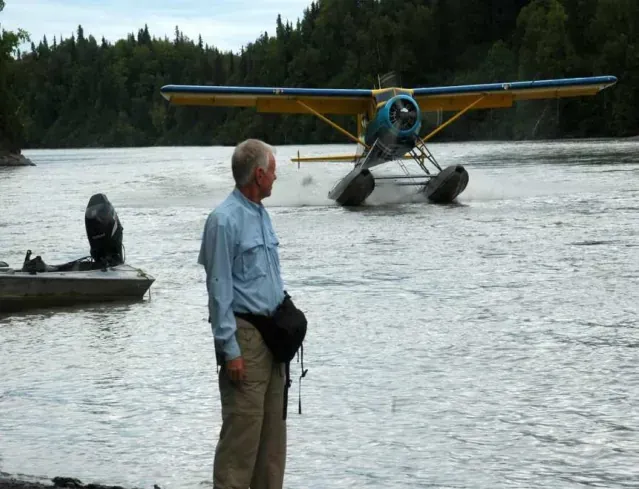 (opens a larger view)
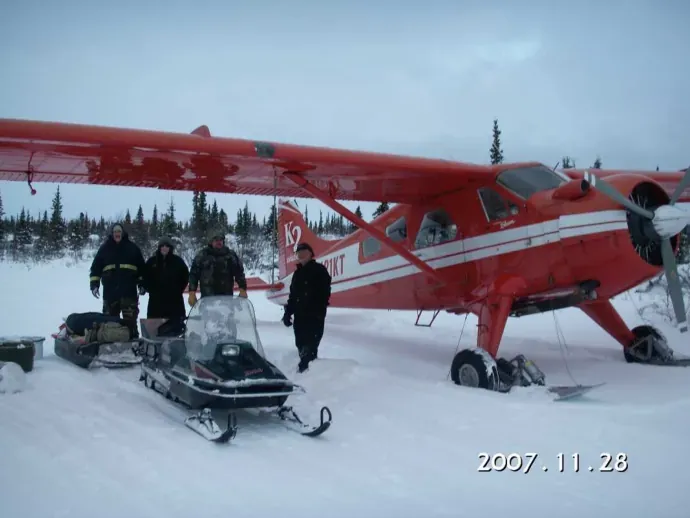 (opens a larger view)