 EAA Chapter 430
W28 Night Light, Revived
Open the PDF at page 3 See the whole April 2017 issue
 (opens a larger view)
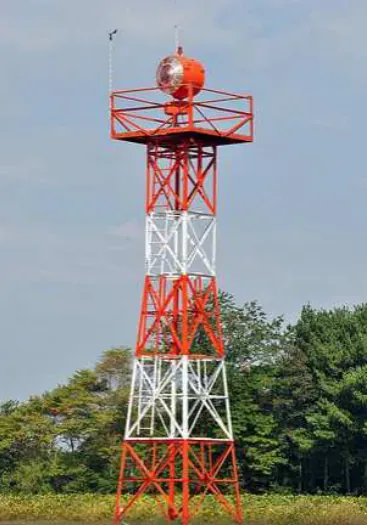
Rotating beacons at airports have been a fixture of the aviation landscape since the 1930’s, and in those early days they were a critical nav aid for both cross country and airport approach navigation. In the 1940’s the Crouse Hinds company developed the quintessential airport beacon called the DCB-225, which was a 36 inch beacon with a 1000 watt or higher bulb, often mounted on a 50 foot tower that still populates many airports, particularly in the wide open territories of the Great Plains. There must be a pilot somewhere who has never seen one of these, but I’ve never met that pilot. The ‘famous’ DCB-225 also had a lesser known little brother, the DCB-10, and that’s where our Sequim Valley airport story begins.
The exact trail of ownership that led Jack Sallee to acquire the rotating beacon on top of the W28 maintenance hangar has been lost over the years, but it is definitely thoroughbred stock.
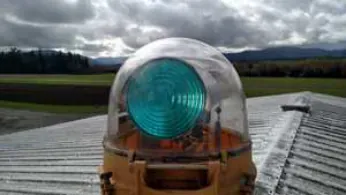
Our Crouse Hinds DCB-10 beacon was built in 1944 with a sturdy glass and steel weather enclosure, brass gears, and a small electric motor that has turned at a steady 5 revolutions per minute for more than 70 years.
Aviation DCB-10’s have a pair of 10 inch Fresnel lenses, one green and one clear, with a 750 watt bulb, now halogen rather than incandescent, in between them. By FAA specs it throws a flash that is angled skyward at six degrees, visible for 20 miles in clear air.
When fitted with other color lenses their weatherproof design made DCB-10’s a favorite of the US Coast Guard for smaller lighthouses, particularly along the southeast coast of Alaska. Although the DCB-10 has a spare bulb on a spring-mounted swing arm for rapid bulb switching, it still requires a human being to tend the light and make the bulb switch, so in the 1970’s the Coast Guard replaced most of its lighthouse DCB-10’s with automated, remotely-controlled lights.
DCB-10’s also require periodic lubrication, and they slowly wear out their specialized brushes that conduct current to the rotating light through a set of brass slip rings. Newer technology lights took over the aviation market, and the Crouse Hinds company left the beacon business in the 1970’s. A few specialized maintenance shops bought up the company’s parts inventory, which was used up in the 1990’s. So any airport with a DCB-10 beacon that needed service or parts was on its own after that.
The day the W28 beacon light went out ‘for good’ isn’t known either, but it was already dormant in 2009 when this pilot first landed at the airport. It had succumbed to the slow but relentless wear on its slip ring brushes, so no current could get to the bulb.
Three nice things about mechanisms designed in the 1940’s are that they are generally sturdy, simple, and have measurements in common fractions of an inch. The circular slip rings on the DCB-10 have a curved bearing surface that is exactly 1-5/8th inches in diameter, which happens to be the diameter of the holes they cut in modern granite countertops for kitchen faucets. And the brush material, which is a self-lubricating alloy of graphite and copper, just happens to be the same material used in brushes for large industrial motors. Armed with the dimensions of one of the remaining brushes in the W28 DCB-10, and a quick search of e-Bay, Amazon and Home Depot websites, the necessary materials and tools were soon in hand. Well, relatively soon. The heavy 1 x 2 x 5 inch industrial motor brush stock costs only $5 a bar but literally came on a slow boat from China, delivered two months after the online order was received by the seller in Shanghai (for a $1 trans-Pacific shipping charge!) After cutting the brush to size on a bandsaw, the perfect diameter curvature on the brush came by drilling a slice of the brush using a 1-5/8” carbide (granite countertop) hole saw from Home Depot, and tapping a couple of 6-32 mounting holes in the top.
Voila. 1944 slip ring brush.
The airport beacon was happily recommissioned in July of 2016 and soldiered on its nightly rotating light duties through the colder-than-normal winter, with one tripped circuit breaker episode apparently caused by freezing temperatures in January. Then in March of 2017 the light went out again, this time for the simple reason the bulb had used up its design lifespan. A new 750 watt halogen bulb was installed in the beacon on April 1. (No, really.) The bulb has a nominal 2000 hr. life, so the question is, how long will this one last, when it comes on at dusk and turns off at dawn each day?
Since pilots think about daylight and night time differently and in more detail than normal folks, this turns out to be a deceptively simple question. (And if you’ve had enough beacon trivia at this point, please go on to the next article in this newsletter now…)
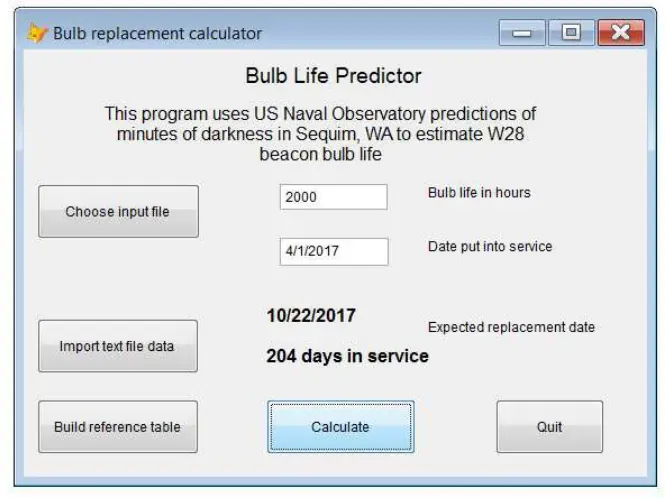
It seems sensible to think that, averaged over a year which has 365 x 24 = 8760 hours, there would be about 4400 hours of darkness occurring annually, and a 2000 hour bulb ought to last somewhat less than six months. Not so fast, Captain. The hours-of-daylight difference between the shortest and longest days of the year in Sequim is over 7 hours(!) and we are heading toward the summer solstice as this article is being written. So your faithful correspondent the beacon guy has done two things. The first is add a digital hour meter to the beacon so the actual time the beacon bulb is turned on gets added up. The second is downloading a file from the Naval Observatory that has the actual number of hours and minutes of darkness each day in Sequim, for which I wrote a computer program that will accept bulb life and start date, and calculate the estimated replacement date for the bulb by adding up the minutes of darkness that accumulate from that start date forward through the year:
To give a sense of the wide swings between dark and light duration in Sequim, the program predicts that the current bulb will hit its nominal lifespan after 204 days of service, in the third week of October 2017. But the replacement put in on that date would last only 137 days due to the extra hours of darkness between October and March!
Over the coming months it will be interesting to compare the program’s predictions with the actual hours of power-on data from the hour meter, to adjust for things like civil twilight and the sensitivity of the photocell dawn-to-dusk switch. Which should be fun on those scuzzy, dark days when there is no flying, and there is excess time to just think about stuff… Oh, and in the meantime if you happen to see the W28 beacon isn’t working, just send an email to the beaconmeister: dmasys@uw.edu