 EAA Chapter 430
Sequim Valley Airport’s Rotating Beacon Goes High Tech
Open the PDF at page 3 See the whole July 2018 issue
By Dan Masys EAA 430 newsletter editor
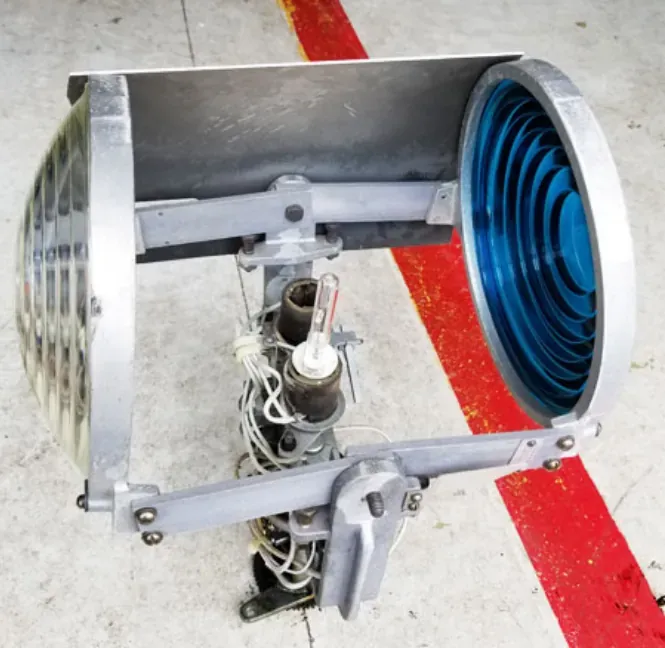
About a year ago – the April 2017 issue to be exact – the chapter newsletter carried the story about the revival of Sequim Valley airport’s rotating beacon. The beacon sits atop the large maintenance hangar and was manufactured in 1944. Since that article, the beacon has done its nightly duty, and received a new electric motor and a couple of changes of its 750 watt halogen bulb, which has a nominal bulb life of 2000 hours. As befits the 1940’s, the beacon’s internal mechanism is pretty simple, as shown here:
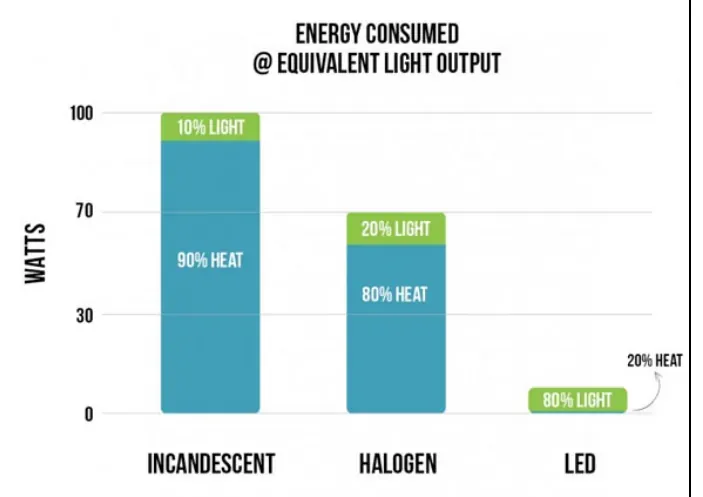
The halogen bulb is positioned in the center and rotates with the clear and colored lenses, while radiating a total of about 15,000 lumens of light energy. At 20% conversion efficiency, halogen bulbs are about twice as efficient converting electrical energy to light as incandescent bulbs, but they still waste 80% of the input, and also run at higher operating temperatures than incandescent bulbs, making cooling a constant concern:
Efficiency further suffers from the spherical radiation pattern of the light from the bulb, less than half of which reaches the lenses of the beacon. (The challenge of converting spherical light radiation into a beam has been addressed for centuries by the use of Fresnel lenses that accept lightwaves from many directions and focus them into a single beam. W28’s beacon has two 10 inch Fresnel lenses, also vintage 1944). Experience over the past year revealed that, while illuminated from dawn to dusk, the W28 beacon has been adding about $150 per month to the airport’s electricity bill, and even at that price has been delivering a relatively modest flash visible for about 20 miles on a clear night.
New Lighting technologies
High power Light Emitting Diode (LED) light sources are creating a revolution in the lighting marketplace due to their 80-90% energy conversion efficiencies and falling prices. LEDs also have the attractive property that their light emissions are inherently directional, so they lend themselves well to applications where a light beam is needed.
Weatherproof LED floodlights with multiple thousands of lumens of directional output have come to market, and prices tend to reflect conversion efficiency: wringing more lightwaves from a single watt of energy requires more exotic diode chemistry and more heat dissipation mechanisms.
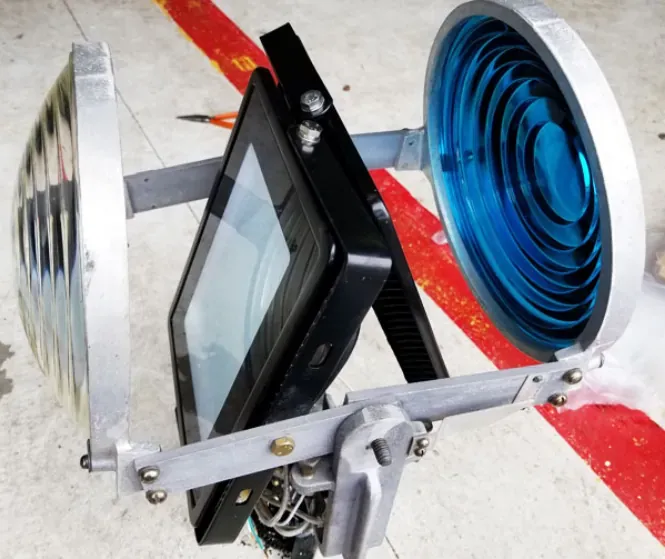
For the beacon upgrade experiment, two 100 watt flat panel LED outdoor floodlight units costing about $35 apiece, each with 8000 lumens of light output were found to fit well within the rotating frame of the beacon, mounted back to back:
One panel shines through the clear lens, and one through the green lens (which looks blue in the picture due to the wonders of cell phone photography). By FAA specs, the lenses are angled upward at six degrees, and the light panels another six degrees beyond that to fill the Fresnel pattern.
By changing over to LED lighting, the beacon’s electrical load dropped by 550 watts, which should decrease the monthly electric bill from $150 to $40 for the airport. But the proof is in the pudding, er, beaming. If you are out flying at sunset or later and you see the W28 beacon on, let us know what you think. Bring your impressions to the next chapter meeting, or send an email to the beaconmeister: dmasys@uw.edu