 EAA Chapter 430
Getting to Know You: Ray Ballantyne
Open the PDF at page 5 See the whole March 2019 issue
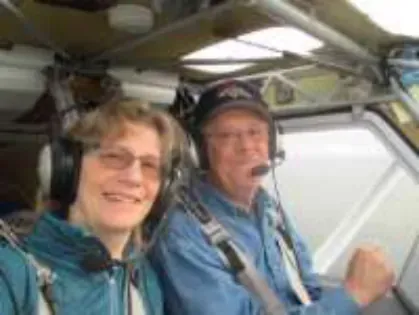
Ray was born with aviation in his blood. His mother trained as a WASP (Women’s Airforce Service Pilot), and his father survived three CG-4A Troop Glider missions in World War II. Ray was less than a year old when he flew in his father’s Stinson Voyager 108 in Pueblo Colorado. Flying Piper Cherokees, Ray had a student license (solo) before a driver’s license on his 16th birthday. He went on to get his private pilot’s license at age 17. He presently has a Commercial, Multi-engine, with Instrument and Seaplane ratings and currently has about 3000 hours.
He received a degree in business administration in 1975 in Gunnison, Colorado and started working at his dad’s livestock trucking company. He met his wife Lisa in college and in 1976, they eloped in a Cherokee 180, ending up in the Las Vegas courthouse where Lisa became Mrs. Ray Ballantyne. They have two children and four grandchildren.
In 1977, he was hired by the Federal Aviation Administration (FAA) as a Flight Service Station (FSS) Specialist GS-7. The first duty station was Cut Bank, Montana (CTB) FSS. After a quick checkout, he was working his first year when his father died unexpectedly and Ray returned to Pueblo, CO to run the truck line and ultimately sell the business six months later. While there, Lisa got her private pilot’s license in a Piper Tomahawk and ended up flying it back to Cut Bank by herself.
Their next assignment was Bethel, Alaska AK FSS (BET) where Ray worked as a level II FSS ATC Specialist. The BET FSS service area was about the size of the state of Oregon with 52 village airports located in the Yukon–Kuskokwim (YK) Delta. Getting to Bethel was an interesting logistical event. The car and household goods were barged to Anchorage and then flown to Bethel in a C-123 “Provider.” Although there are no roads to this village of 4000 people 350 miles west of Anchorage, it is important to have a car to get around town. In the winter, the Kuskokwim River freezes thick enough to drive to nearby villages. Ray and Lisa flew their 1969 Piper Co-manche 260C all the way to Bethel, flying IFR the last leg on G7 (an NDB airway) because there were no VORs or GPS. The YK delta had a lot of air traffic with numerous C206/207 and C185’s supplying all the villages. Ray got to visit most of the villages in the delta and the north country as he also flew as a Part 135 “bush” pilot on his days off in Bethel and later in Fairbanks.
In 1981, Ray was selected for Fairbanks (FAI) Airport Traffic Control Tower (ATCT). He successfully completed the Academy training in Oklahoma City (OKC) and reported to FAI for training in August.
Meanwhile, in August 1981, the Professional Air Traffic Controllers Organization (PATCO) 15,000 members struck and walked off their posts. After negotiations collapsed in what was declared an illegal strike by President Ronald Reagan, he offered them 48 hours to return to duty. Most of the striking controllers eventually lost their jobs and had no option for rehire for over a decade. Supervisors, non-strikers and military controllers took over as commercial flights from the larger airports were cut by 50%. Ray’s class was the first to graduate OKC after the strike. He worked 10 hour shifts 6 days a week as a controller in the FAI combined Terminal Radar Approach Control (TRACON) and Tower Cab, which included controlling Ft Wainwright AAF and Eielson AFB. He served not only as a controller, but was the Quality Assurance, Automation Specialist, temporary Operations Supervisor and trainer.
After 3 years in Fairbanks, he and Lisa ended up back at Bethel (the only place he said he would never live). Ray was the Air Traffic Manager (ATM) for 18 months and established perhaps the last non-Radar approach control in the country. From there they moved on to Colorado Springs (COS) as an ATC Specialist from 1986 to 1989. COS at that time had a difficult triangle runway configuration with extensive military training aircraft mixed with commercial and civilian operations.
In March of 1989, they drove back to Anchorage with their two young children, Amy and Dan, where Ray worked as a tower controller at Anchorage ATCT (ANC), which included tower control of Lake Hood Seaplane base, the busiest in the world. A week after they arrived in Anchorage, the supertanker Exxon Valdez ran aground, spewing 11 million gallons of crude oil into Prince William Sound. The call came early in the morning from the Air Traffic Division Manager asking Ray to go manage the increased air traffic over Prince William Sound, off the Gulf of Alaska, from a Coast Guard cutter. In his words, “I was a likely candidate to go because I would not be missed at the tower, I had high-density/complex air traffic control experience, and I knew as much about the Prince William Sound area as anyone else – not much.”
Working from the Coast Guard cutter Rush, Ray and his coworker Don Hall worked from the Combat Information Center (CIC) of the Cutter. Their transportation to the Rush was an H3 helicopter which was too large to land on the cutter. They were lowered down in a wire basket with a winch to the flight deck. Ray’s unique story, written by him, appeared in the July 1989 issue of the AOPA Pilot. You can read it at the following link on our EAA 430 web site.
From 1990 to 1993 Ray worked as a System Requirements Planning Specialist at the Alaska Regional Office, analyzing the air traffic system and identifying Air Traffic requirements to ensure the requirements of the NAS. Representing Alaska on the Advanced Automation System (AAS) and Voice Switch and Communications System (VSCS) Implementation Teams, he also served on the national budget allocation team. For the following three years, he was the Anchorage TRACON Operations Supervisor, Operations Manager, and temporary ATM.
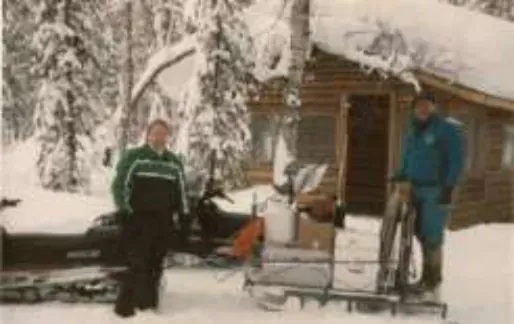
During the Iditarod sled dog race, Ray, along with two other controllers, set up a temporary control tower at a remote site. They loaded a 200-pound sled filled with survival gear and radio equipment and, pulled by a snow machine, they traveled 65 miles to Skwent-na. For three days the three men manned the “control tower” which recorded over 200 operations. Besides the ski planes, they had to keep an eye on the runway for cross-country skiers, snow machines, moose and dogs…all of this sitting out at -30 degrees.
Ray became the Merrill ATCT ATM for three years, a facility that averaged 175,000 operations per year. Merrill is a public-use general aviation airport located a mile from downtown Anchorage. While he was there, the Merrill ATCT received the Regional Facility of the Year award and the National Facility of the Year. He also led the move to a new tower, for which he had started the budget process while working in the Regional Office.
After sixteen years in Alaska, the next stop was Portland, Oregon as the Oregon Terminal Hub Air Traffic Manager. Ray oversaw the commissioning of the new Portland ATCT (PDX) and was the first facility to field the new Enhanced Terminal Voice Switching system (ETVS) nationally. PDX was also selected as national Facility of the Year in 2000.
From 2003 to 2006 Ray was a Quality Assurance Specialist for the FAA Western Service Area Safety Assurance Group in Seattle. With the kids out of the house in 2006, he moved with Lisa to Los Angeles Air Route Control Center (ARTCC) in Palmdale, CA where he was the Support Manager for Quality Control. Following three years at LA Center, Ray was assigned to FAA Headquarters in Washington DC, to address quality assurance for all the towers in the FAA. In 2010, he ended his career in Seattle as the Senior Advisor to the Western Terminal Service Director.
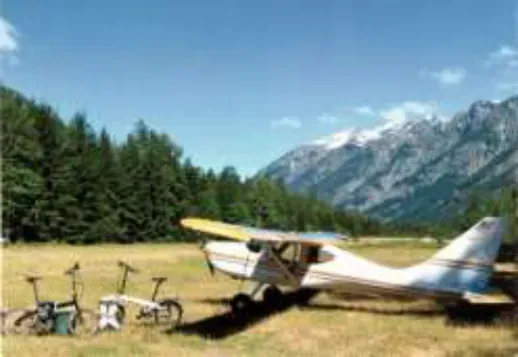
After 35 years working at his “dream” job, Ray retired and moved to Sequim, Washington where Lisa was the general contractor while they built their home at Rake’s Glen Airport WA59. Ray is Secretary for EAA 430 and started the VMC Club this past year. He and Lisa spend a lot of time backcountry flying and camping in their GlaStar GS-1. They are planning a summer trip, flying their plane, along with two other planes, to Alaska.
Ray has owned a Comanche, Tomahawk, C182, Bonanza BE35S, and currently has the GlaStar. Although not a builder, with the help of EAA 430 members, he has modified his GlaStar with a Powerflow exhaust, EMag replacement, changed the gear from tricycle to conventional, and installed a constant speed propeller.