 EAA Chapter 430
Off to the War (Pearl Harbor)
Open the PDF at page 7 See the whole July 2019 issue
Note from the Editor: I was privileged to spend several months interviewing Lee Embree and subsequently writing his memoirs. We would sit in his Port Angeles home, drinking coffee and eating cookies, while he told me stories of his career as the official photographer in the Army Air Corps. Many of his photographs were featured in Life magazine and in the news reels viewed in the movie theatres. One of my favorite stories he shared is the trip in one of several B-17’s to Hickam Field in Hawaii, on their way to the Philippines, arriving at the same time the Japanese were bombing our Navy ships in the harbor…December 7, 1941. Lee passed away on January 24, 2008 at the age of 92 years old. The following is an excerpt from his memoirs.
Each B-17 aircraft of the squadron was assigned a permanent flight crew. In addition to the regular crew, two aerial photographers, a communications officer, and later a flight surgeon were added to the air echelon PCS (permanent change of station) flight. Other squadron personnel were to travel by surface transportation.
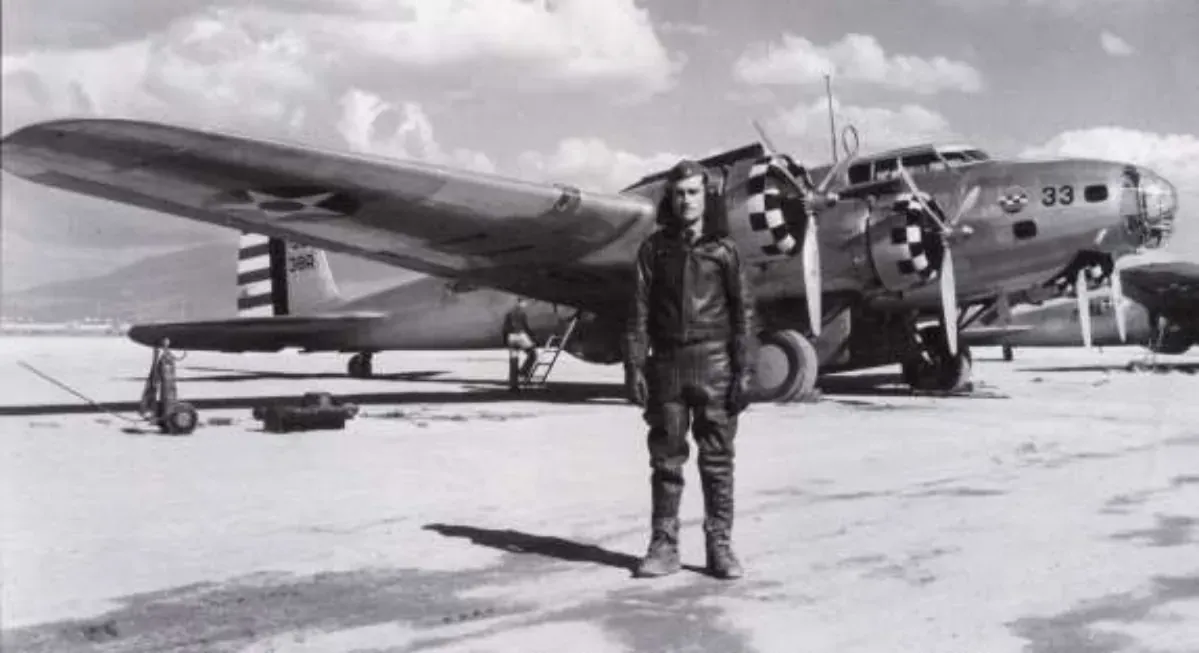
As an aerial photographer, I was assigned to Capt. Raymond T. Swenson’s crew on a B-17B, (Serial number 38-212). On November 19, our crew departed on an extended cross-country in our assigned aircraft for a shakedown flight. First we flew to Maxwell Field in Montgomery, Alabama, then Langley Field in Virginia. At Langley we exchanged our “B” model for a “C” (Serial 40-2074); then we left for Bolling Field near Washington DC. Captain Swenson had arranged for a staff car, and he had one vacant seat. For what reason I don’t know, but he invited me to go along. This was to be a sight-seeing trip around the capitol and other famous places. This was my first trip to DC, and I was simply overwhelmed by everything.
Early the next morning we departed for Middleton Air Depot in Pennsylvania for a few minor repairs and parts. Now for the shakedown flight to Albuquerque, nonstop by way of Chicago, Denver and over Albuquerque to El Paso; then we returned for landing at Albuquerque. Our flying time was approximately fourteen hours. It was a good airplane and a very tired but happy crew. We had just completed the simulated flight from San Francisco to Hawaii, the longest single over-water flight en route to the Philippines.
It was a late night landing in Albuquerque on November 24th. Betty was there at the flight line to meet me in our ‘38 yellow Studebaker. To my surprise, so were my parents and brother and sisters. They had driven down from Iowa to see me off to Hawaii. It sure was nice to see them. We had a nice long visit the next day; then they headed home.
The next day I received another surprise. Our Squadron Commander, Major Truman H. Landon, asked me to change crews for the upcoming flight to the Philippines. Field.” He said, “I want you on one of the two new B-17E models which the squadron will receive at Hamilton Field.” (Hamilton is located at San Rafael, California, on the north part of San Francisco Bay.) He added, “These new “E” models have a 24-volt electrical system which will be compatible with the aerial camera you will be taking on the flight.” The “C” and “D” models were 12-volt systems; therefore, the need was obvious for my crew and aircraft reassignment. Major Landon also told me, “On our flight to the Philippines, we’ll be flying over some islands occupied by the Japanese. I want you to get some good aerial photographs because we think they are up to something we are not supposed to know about.”
When Captain Swenson’s other crew members were informed of my reassignment, I remember a comment by the Crew Chief, M/Sgt. Leroy Pouncey. “Well, that’s too bad, because now you’ll miss some of that good fruitcake my wife is making for me to take along.” My new assignment resulted in changing places with the Flight Surgeon, 1st. Lt. William R. Schick. Prior to this, I was not aware that we would have a medical officer accompanying the flight. The pilot of the new plane to which I was assigned was 1st Lt. Karl T. Barthelmess.
Early on the morning of December 4, 1941, Betty drove me to the squadron flight line, then headed for Los Angeles in our trusty `38 Studebaker with another crew member’s wife. Betty would be staying with her father and mother. It was a day of very mixed emotions for me. On that day, our air echelon was scheduled to depart from Albuquerque. I would not want to relive that day again - ever. On the one hand it was very difficult for me to realize that I would not be seeing Betty for probably a very long time. We were married on February 22, only about nine months earlier. We had enjoyed the Albuquerque life, and it was there we had our first home. On the other hand, I think most of us were looking upon this as a new and exciting adventure. After all, flying in a B-17 to the Philippine Islands was not something very many twenty-six-year-olds had an opportunity to do. Later on, Lieutenant Schick was overheard to say, “I wouldn’t take a million dollars for this trip!”
Later that morning we flew to Hamilton Field. Since our crew was scheduled to receive one of the new “E” models, three of our crew were ferried to Hamilton in a B-18. Besides myself, there were Sgt. Vance Spears, S/Sgt. Nicholas Kahlefent, plus a plane load of equipment. Upon arrival at Hamilton, crew members spent their waking hours checking and double-checking equipment - both personal and the aircraft.
The next day I located our new model “E” on the flight line. T/Sgt. Roy Coulter and Sergeant Spears were giving it a good check-out. How different it looked with the dull olive drab paint job and no markings on the tail - not even an identification number. It was eight feet longer and had twin .50-caliber machine guns in the tail. The crew entrance door was farther back and much easier to enter. Bomb bay fuel tanks were in place to provide the extra flying time needed for the long haul to Hawaii. All fuel tanks were being topped off to the last possible ounce. I heard a sergeant remark after filling one tank, “There isn’t room for another teaspoon of gas in this one.” There were, of course, changes and updating modifications, which made this plane, Number 41-2408, a really formidable Flying Fortress. (Many years after the war, I learned that this same B-17E was one of the three used to fly General MacArthur and his staff out of the Philippines during March 1942.)
We were all processed for overseas duty and final inspections were made. It was quite a sight to see those B-17’s lined up on the flight line. There were also eight from the 88th Reconnaissance Squadron out of Salt Lake City, which were being reassigned to the Philippines.
An hour or so before we were scheduled to depart, I phoned Betty in Los Angeles. She had arrived safely from Albuquerque. After we talked for a while, I could hear her mother saying something in the background. So I asked, “What is she saying?”
“You tell Lee to be careful because those Japs are going to cause trouble,” was the message my wife relayed. I said, “You tell her not to worry and don’t believe everything you read in the newspapers.” Little did I know how wrong I was and how right she was. That conversation took place about 8:00 p.m. on Saturday, December 6, 1941.
Shortly after the telephone call, all flight crew members were summoned into a rather small room (for 144 men) for a final briefing and flight plan. A briefing officer (I believe it was Brigadier General Fickel) walked in, and the door was closed. He talked about the route and stops we would make enroute to the Philippines. He especially emphasized the care and precaution necessary to safely complete this first, long, over-water flight to Hawaii. He explained that we would not take any machine-gun ammunition along on this first hop because of the distance and the need to keep our weight down and thus conserve fuel. Numerous other items were discussed. Then he closed the meeting by saying, “Good luck and good bombing.” As we were leaving the room I overheard him telling one of the flight crew officers that plenty of machine gun ammunition would be ready for us when we arrived at Hickam Field. I also noticed on leaving that the Chief of the Army Air Corps, Gen. H. H. “Hap” Arnold was standing at the base operations counter talking with someone. He had arrived earlier in a C-39, apparently also to see us off.
About 9:00 p.m. we were told to load up. As I climbed into the aircraft, I made sure my two pieces of luggage were on board. The GI B-4 bag was crammed full of clothing and other personal effects. But more important to me was my own personal camera, a 4x5 Speed Graphic. I planned to use it in the Philippines for taking pictures to send home to my wife. It was pretty much a standard camera used by news photographers at that time.
Lieutenant Barthelmess asked me to go up forward in the greenhouse for the takeoff and part of the flight. With the heavy load of fuel, tool boxes, luggage and machine guns on board, it would help a little to have my weight up there to help correct the center of gravity. I don’t know what our take-off position was; however, since we were crew number two, I assumed we also were number two to roll. With the brakes locked, those four engines began to thunder. The pilot released the brakes and we started rolling down the runway. It was about 9:30 p.m. Being up in the nose of the plane, the ground seemed very close, especially after the tail elevated. What disturbed me most was the row of red lights, dead ahead, marking the end of the runway. After what seemed to me like many minutes, I felt the main landing gear wheels still on the ground. To this day, I believe those wheels rolled between the red lights. Then the nose lifted, and we were over the water of northern San Francisco Bay, still low, but gradually gaining altitude. Finally, we were over the Golden Gate Bridge. Nothing but black night lay ahead.
Each B-17 was scheduled to leave Hamilton Field at five or ten minute intervals, then fly and navigate individually to Hickam Field. The reason for this was that on such a long night flight, formation flying would be extremely dangerous and very tiring. It would also have increased fuel consumption considerably.
The crew of this new model “E”, in addition to Lieutenant Barthelmess, our Pilot, included 2nd. Lt. Larry Sheehan, Co-Pilot; 2nd. Lt. Charles E. Bergdoll, Navigator; Air Cadet John C. Adams, Bombardier; T/Sgt. Roy H. Coulter, Crew Chief; Sgt. Vance H. Spears, Asst. Crew Chief; S/Sgt. Nicholas H. Kahlefent, Radio Operator; Corporal Raymond R. Joslin, Asst. Radio Operator; and me, S/Sgt. Lee R. Embree, Aerial Photographer.
As the hours ticked by, I tried to cat nap a little, but without much success. Our Navigator was working constantly and, of course, we tried to keep out of his way. Radio contact with other crews was limited to each pilot reporting in to Major Landon at scheduled times. We learned later that sometime around daybreak, we apparently passed a Pan American Clipper which was scheduled to land in Pearl Harbor at 9:30 a.m. I have no information on where it finally landed, but I think it was diverted to Hilo.
I stayed up in front all night because the engine noise wasn’t quite as loud. It was a very long and tiring night, but uneventful - so far. At the appointed time, after daylight, our Navigator said we should be sighting the island of Oahu. Minutes ticked by and still no sight of land - only dark cloud formations on the horizon that looked like mountains. Finally Lieutenant Barthelmess asked Nick, our Radio Operator, to check the compass indicator in the Navigator’s position to see if it was synchronized. Nick said it was okay. Next, the Pilot told the Navigator he would do a slow 360-degree turn to give him time to take another “fix” and recalibrate our heading. This we did, and Lieutenant Bergdoll insisted we were on the correct course. Shortly after that, we sighted land. Real land! What a relief to see something besides water. We were getting worried about the gas supply because when we sighted the island of Oahu, we had about one hour supply left.
We headed for the west side of Oahu which brought us around Diamond Head. As we approached the islands, I left the greenhouse and crawled back through the pilots’ and crew chief’s compartment and along the bomb bay cat-walk to the radio compartments. This is where Nick and Ray had spent the night. They looked beat. I told them I was going on back to unpack my camera. I wanted to try with my own camera to get some good pictures of the famous places I’d heard so much about: Diamond Head, Waikiki Beach, Royal Hawaiian Hotel and Honolulu.
With my Speed Graphic in hand and loaded with a film pack (12 shots), I headed for the rear waist gunners’ positions - one on each side. There were no machine guns in place at the time and no Plexiglas in the window openings. It was perfect for photography! I saw Diamond Head and then Honolulu. I thought, Wow! We really have made it to the Hawaiian Islands! For an Iowa farm boy, this was living. I took a shot out the right window.
By now we were about a mile off Waikiki at about 2,000 feet altitude. This was in keeping with a normal over-water approach for landing at Hickam Field. Suddenly I saw large clouds of black smoke rising from Hickam or beyond. It was similar to a huge oil well fire. But there was more intense smoke from different locations. I wondered what was going on. By this time, we were farther out from the shoreline, almost ready to turn right for the final approach to Hickam. Next, I observed hundreds of small black puffs of smoke above Hickam and Pearl Harbor. Then I recalled seeing the same thing back home on the movie theater screens of newsreels showing the war in Europe, including the anti -aircraft firing. I began to sweat, and not just because of the warm tropical air whistling in my face. As we turned right on final approach, I remember jumping over to the left side window opening, camera still in hand. Something really crazy seemed to be going on out there. Up ahead I saw airplanes going in all kinds of directions. Then I noticed considerably more black smoke. We were now down pretty low and flying directly over the entrance to Pearl Harbor. Suddenly I saw and felt the bomber pull up with a surge of power and start to gain altitude.
I was alone back in the tail section, and I didn’t have the intercom headset on, so I didn’t know or understand what the heck was going on. Later, after we landed at Hickam, I was told the pull-up was because of intense Japanese aircraft activity over the Hickam runway and hangar area. As we flew over the runway, I got a good close look at some of those wild flying airplanes and saw the red meat ball painted on them. Were they really Japanese airplanes? It still hadn’t soaked in. We made a go-around, turning left around the outside edge of Pearl Harbor. I couldn’t believe what I was seeing. Many ships in the harbor were burning and exploding. Airplanes were climbing, turning and diving all over the place.
During the years since that morning of December 7, people have said to me, “Why didn’t you take more aerial photos of all this?” I don’t really know why, but I believe it was because I was so flabbergasted at what was happening that I momentarily forgot the camera was in my hand. I have wished many times since then that I had banged away with all that film in my camera. Reminded of the newsreels I’d seen back home, it took time to soak in what was really happening.
We continued our slow left turn, coming out over the water again just east of Barber’s Point. Lieutenant Barthelmess turned left just off the shoreline for another final approach to Hickam. As we passed over Pearl Harbor entrance again, I saw a Navy ship of some kind coming out of the harbor. It was firing, all guns almost straight up. Just then I saw something that looked like a bomb fall in front of our left wing. I looked up and saw an airplane with those red meat balls on each wing. The pilot of that plane was obviously trying to bomb the Navy ship just below us, and they in turn were trying to hit the Jap plane. And here we were, flying right between the two! We were lucky this time and didn’t take any hits. I remember saying to no one in particular, “Please, Lieutenant, get this crate on the ground, fast!” We had guns in the plane, but they were not mounted.
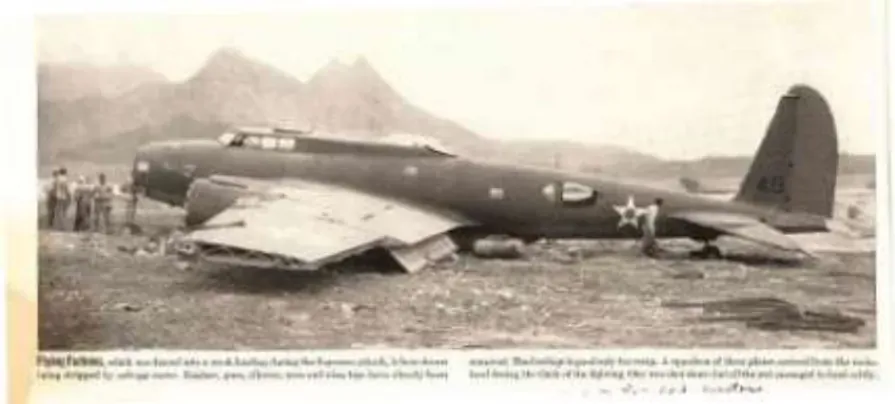
Again I heard and felt that surge of those four powerful engines. I couldn’t believe this. As we passed over the runway, I saw a B-17 on the Hickam flight line with its tail-end burned off and its nose pointing upward at about a 45º angle. The stabilizer and control surface part of the tail end was several yards off to one side. We did another go-around, using the same flight pattern as the first time. The anti-aircraft fire had become more intense. It seemed like all of Hickam Field was burning. Heavy black smoke poured from many of the Navy ships, and there were repeated explosions on some of them. On this second go-around, Lieutenant Barthelmess followed pretty much the same route on his final approach, flying just off the shoreline. I was still hanging on at the left window opening. This time around was more turbulent. I had been bounced around quite a bit back there in the tail section by both the turbulence and, I suppose, our pilot trying to avoid other aircraft. During some of this rough treatment, I remember trying to protect my camera. Then it hit me. Hey! I should be taking pictures from this vantage point in the air!
At about the same instant, I heard what sounded like hailstones falling on a tin roof. I looked back and saw two fighter-type aircraft right on our tail The hailstone noise was, of course, their machine gun fire hitting the sheet metal of our tail surfaces. That was getting a little too close for comfort because I was in the tail section. Then for some reason, they stopped firing and passed us on the left. I heard later that some of our shore batteries with .50-caliber machine guns saw them on our tail and opened fire. Maybe it got a little too hot for them, and they decided to leave. They passed so close I could see the Japanese pilots. They were grinning from ear to ear. Looking out over our left wing, I took a shot of those two and heaved a sigh of relief. We were now on final approach and slowing down considerably, so they disappeared very quickly - but not for long. Moments later, the same two appeared under our left wing, diving and flying in the opposite direction. A third aircraft was in front of them, which crashed and burned. It was not possible to identify this third aircraft; however, I did take a shot of the two and of the one burning.
Then Nick opened the radio compartment door and yelled to me, “Lieutenant Barthelmess says on intercom we’re going in to land this time, regardless, because the fuel gauges are showing empty.” I hoped they could stretch the glide path to the runway, and sure enough they did as the landing gear tires squealed on the runway surface. After attempting to land at Hickam Field three times, we were down at last!
All four windmills were still turning, so we taxied off to the right, over to what they called the dispersal area, and stopped. The pilots shut down the engines, and for the first time in about thirteen hours, everything was quiet. But not for long. A man driving a tow tug came racing up to the left side of the plane where I was still at the gun turret window and yelled, “Get out of there fast! We’re being attacked by the Japs!” That cinched it. His words immediately erased any remaining doubt that may have lingered in our minds. We were in a war!
T/Sgt. Coulter, our Crew Chief, came back through the plane and said, “Let’s get out here! But first throw out anything that might burn in case some incendiary strafing comes our way!” So we started throwing luggage out the door - fast. I jumped out the door with my camera and began moving luggage and other gear out and away from the plane. Just then I heard the sound of planes approaching from somewhere. Somebody yelled, “Duck!” I hit the dirt. I think there was only one plane that came over, strafing.
When I picked myself up off the ground, I noticed that two brass buttons at the bottom of one leg of my GI fatigue coveralls were missing. I couldn’t believe it (and probably no one else would either), but they apparently had been shot away. With that, I sort of checked out myself, but not a scratch anywhere. I showed this to Roy. His comment was, “That’s getting pretty close.” He was more concerned about his plane because he was a darned good crew chief. He then stripped off his shirt and went about checking the “E” for any damage.
The plane had been hit several times while in the air, but there was no serious damage. I took a photo of the vertical stabilizer which showed only one hit. I then walked around to the front of the plane and took a photo of the nose and left wing engines, with a large black smoke plume showing under the wing in the background. It was later determined that the smoke was from the crippled battleship, Arizona. In the background was also another B-17, but I didn’t know to which crew it belonged. Next, I came back near the right wing tip and took a photo of the rear part of the plane, with our luggage and equipment out on the ground. My open camera case would be seen nearest the open door.
The attack seemed to be over now. At least I didn’t see any more Jap planes flying around; however, there were still quite a few explosions taking place around Hickam and back in the Pearl Harbor area. They wanted us to go back up and try and find the Japanese fleet; however, they could not find any gasoline or bombs for our airplane, so we did not go. That night, before sundown, a truck came out with some coffee and sandwiches for us. It was cold coffee , but so what if the coffee was cold? After flying all night and arriving for this Jap reception, any kind of food was most welcome.
After eating, I picked up my camera again and took a shot of the Hickam hangars and flight line. The hangars were smoking and in ruins. A B-18 had taken a direct hit in the crew compartment. It was burning fiercely when we landed and taxied past. I didn’t see any planes on the flight line that were not damaged or destroyed. This scene reminded me of some news photographs of the war in Europe. It really was very difficult to believe that this was for real, here in the middle of the beautiful Hawaiian Islands.
In the hangar line photograph showing the black smoke billowing from one hangar, is the B-17 I mentioned earlier, which had burned apart at the radio compartment. It is not very clear in the flight line photo; however, just below where the smoke is emerging, it is visible with no tail section. I didn’t know at the time that it was Captain Swenson’s B-17C. This was the same plane to which I had originally been assigned back in Albuquerque only three days earlier. It was quite a shock when I learned about the plane’s identity.
(Editor: The Squadron Commander later told Lee, “I have some bad news. The flight surgeon you changed places with was the only one killed.” The strafing from the Japanese fighters got him. He was the only one from our squadron who was killed. It still hits me pretty hard.”