 EAA Chapter 430
Getting to Know You: Rick Vaux
Open the PDF at page 8 See the whole February 2020 issue
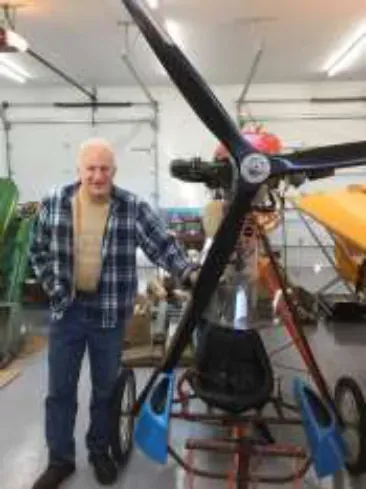
“When I was four years old, my dad took me to the Renton airport where we watched through the fence the airplanes landing and taking off.” This is the first memory Rick has of his beginning fascination with airplanes. “My uncle gave me my first flight in a Piper Tri-Pacer and he let me fly the plane.” All through school in Seattle WA, Rick built model airplanes. The aviation bug had bit.
After high school graduation, he talked to a Marine recruiter and was promised that if he signed up for four years as an active Marine, he would receive an aviation guarantee. His first duty station was at the Marine Corps Air Station in El Toro, California as a helicopter mechanic. Since there were no helicopters at El Toro, he was assigned to a Douglas A-4 Skyhawk Squadron, where he served as a plane captain. Six months later he was reassigned to a Helicopter Squadron at MCAF Santa Ana where he served as a C-46 Crew Chief until leaving active duty. He subsequently got his A&P license at Seattle Community College.
Next stop was Everett Boeing, working on the 747 for nine months, until being laid off, along with hundreds of other employees in 1970, with no aviation jobs available in the area. He was offered a job in Amarillo, Texas, working for Bell Helicopter. He worked in sheet metal and teardown of helicopters arriving from Vietnam, a job he enjoyed for two years.
In 1972, Scottsdale Aviation offered him a job as a mechanic, and he and his wife, Cathy, moved to Mesa, AZ. He spent nine months working on contract for four fire-fighting helicopters. He spent time in Cobb, California, before returning to Arizona. In early 1973, Rick changed jobs when he went to work for Aviation Specialties in Mesa, Arizona. The company converted Sikorsky H-19 helicopters to turbine power. After a three-month US Forest Service fire contract in Salt Lake City, Utah, he went looking for a more stable job.
Hughes Air West in Phoenix, AZ hired him to work on the DC-9 and F-27. He also worked at the Orange County Airport (John Wayne Airport) for Hughes.
In 1980, his next adventure took him to Air California which was later bought out by American Airlines. At this time he wanted to try out Management and became a Line Supervisor for Air California for five years. Deciding it was not a fit, he decided to go back to his career as a mechanic. His desire to get out of Southern California in 1989 brought him to San Jose, which resulted in his commuting back to Santa Anna when he was unable to sell his house. He returned to Southern California to an inspection job at LAX as a radiographer and instructor for the next fifteen years, after which he and Cathy moved to Reno, Nevada, for two and one-half years until he retired in 2005 after 25 years with American Airlines.
While living in Southern California, Rick was a member of EAA Chapter 7 where he served as a tech advisor and wrote a monthly column for the newsletter. He is also a tech advisor for EAA 430. As a life-long athlete, he participated in many sports, including rowing and playing soccer and baseball.
Having been an A&P since 1965, he is a master mechanic. He has a commercial license and ratings in the following: multi-engine, IA and glider. He was working on his instrument rating until he ran out of money. He owned an Aeronca 7AC Champ and has flown the following aircraft: Bonanza, Beechcraft Musketeer, Piper PA-28 Cherokee, Citabria, J3 Cub, Clipped Wing Cub, C-150, 172, 182, 190, 310 and Gliders. (continued on next page)
Since childhood Rick has had a passion for music. When he was nine years old, he sang soloes in his church. In 1964, he sang in Japan with his high school chorus. He sang in the Boeing Choir and was a member of the Peninsula Singers. He plays the guitar, banjo and ukulele.
When asked if he has had any harrowing experiences in his career, he tells about working on the 737 during the nightshift in Reno, a below-zero winter night, when he needed to check the engine on the plane. He was on a creeper, under the plane. Finishing up his inspection, he realized the creeper had frozen to the ground, making him unable to move from underneath the plane. Since he was the only one on the airfield, he yelled until someone finally heard him and came to his rescue. It took three men to break enough ice to free the creeper and he was able to move out from under the plane.
Another harrowing story was the day he was driving a fuel truck with helicopter fire-fighting equipment in a Montana forest fire. A fuel truck carrying 6000 gallons of AV gas also needed to reach the fire fighters. The only way to reach the fire fighters was to drive 1.5 miles on a dirt road through the fire. He suggested to the driver of the fuel truck that he follow behind him (just in case) and they both drove as fast as they could to get through to the other side.
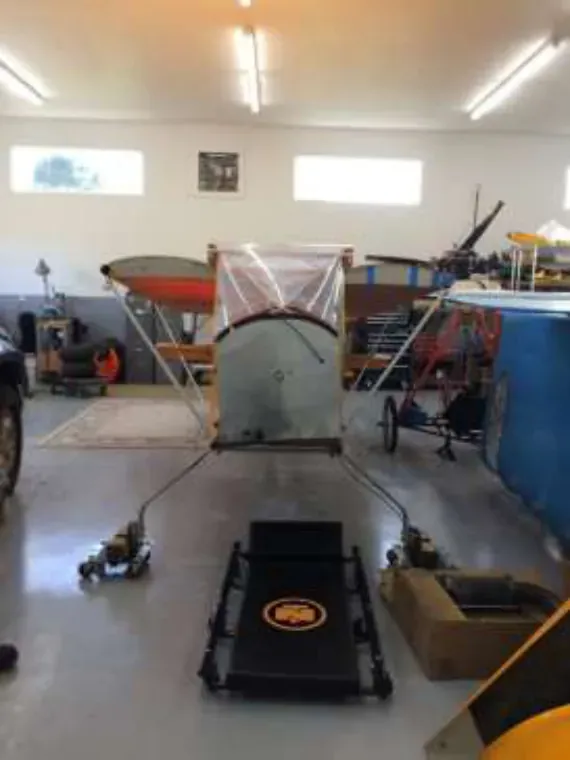
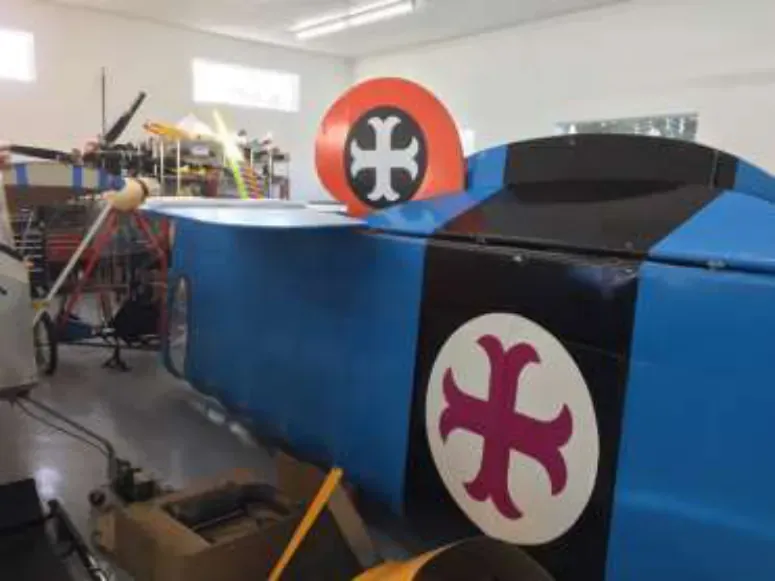
After his retirement, he worked as a docent/researcher at the Seattle Boeing Museum of Flight for ten years. He and Cathy moved to Sequim in 2017 and purchased a home in Happy Valley where they remodeled their basement, adding Rick’s “man cave.” They built a hangar on their five acres where Rick is restoring two ultralights with plans to finish constructing a grass strip on the property.
He and Cathy are the parents of two sons and grandparents of six grandkids. Now that they are retired, they enjoy traveling.
After a lifetime focused on aviation safety, Rick’s advice to EAA members is “Always get a second pair of eyes.”
GETTING TO KNOW YOU RICK VAUX
More photos
 (opens a larger view)
 (opens a larger view)