 EAA Chapter 430
Aviation From My Rocking Chair
Aviation From My Rocking Chair: JN4 “Jenny” 1918
Open the PDF at page 5 See the whole April 2021 issue

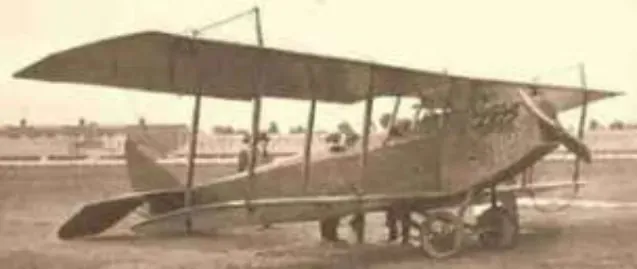
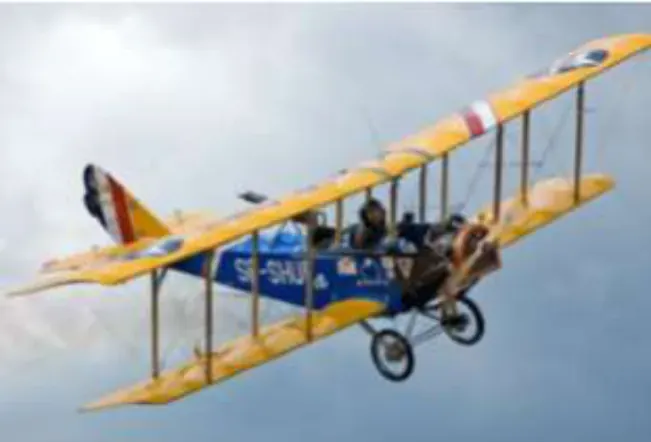
Hello again, Chapter 430. I have always been fascinated by history and Aviation history in particular. This month, in order to get away from technical topics, let’s take a journey back to Hammondsport, NY where we find the Curtiss Airplane Co. building JN4 “Jennys.” The year is 1918 and the U.S. is in it’s second year of WW1.
How many Jennys flew away from the factory in 1918? If you answered anything other than NONE, you were wrong! Not a single aircraft ever flew from the factory. They were sent to customers by rail. The following could be the precursor to the modern 51% rule.
“The component parts are packed for shipment in two cases. The case is designated by the name of it’s major contents, as: 1. Fuselage 2. Panels”
(1) The fuselage contains the motor set in place. The instrument board and instruments all connected up. The carburetor control and adjustment, throttle control, spark advance control, and magneto cutout switch, all connected up and ready for operation, and the tail skid in place. The control bridge is in place, the leads attached to drum and wheel of bridge for operating the ailerons will be found wrapped around the seat rails. The leads for controlling the elevators will be found attached to the sides of the U-Bridge, with ends passed through fairleads and coiled up in the fuselage, back of the pilot’s seat. The rudder control wires are attached to the foot control bar, and leading to the rear end of the fuselage cover, are coiled up ready for leading through the fuselage for attachment to the rudder. The landing gear, completely assembled without wheels and with cross-stay wires connected up but slack, also packed in the case. The wheels for the landing gear, the propeller, and the exhaust equipment will also be found in this box.
(2) The Panel box contains all the panels with sockets and hinges attached. The transverse and longitudinal wires will be found attached to the underside of the upper wing, coiled up and ready for attaching to the lower wing. The aileron control pulleys are all in place on the underside of the upper wing; the aileron control cables are passed through these pulleys and coiled up— shackles and pin at one end for attaching to the control pylons of the aileron, and turnbuckles at the other end for attaching to the “lead” coming from the control bridge and through the side of fuselage. This case also contains the elevators and rudder, with control or operating pylons removed. All the control or operating pylon for the ailerons, elevators, and rudder are packed in this case. Also, all the panel struts and engine section struts are packed in this case”.
Have any trouble with the nomenclature? Me too! I haven’t been able to determine how large these boxes were, but, consider the JN4 fuselage from prop hub to tail post is approximately 22’3” long x 48” deep x 27” wide. The upper wing spans 47’ 7 5/16” with a 4’ 11 1/2” chord and the lower wing spans 34’ 8 5/16”. When that UPS truck arrives we are going to need a really big garage.
Well troopers, again I have resorted to plagiarizing other authors’ work (this one came from the “Aircraft Mechanics Handbook” dated Mar. 1918) when I have run out of ideas and airspeed at the same time. I wish all blue skies, and I think I’ll put my #2 pencil down for another month.
Rick Vaux TC 4130
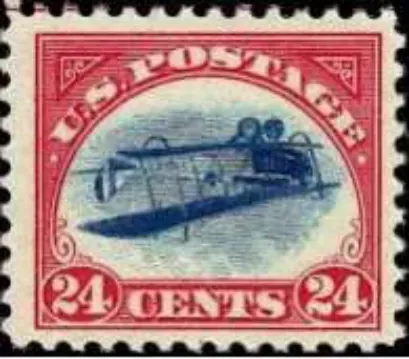
The Inverted Jenny is a 24 cent United States postage stamp first issued on May 10, 1918, in which the image of the Curtiss JN-4 airplane in the center of the design is printed upside-down. A single Inverted Jenny was sold at a Robert A. Siegel auction in November 2007 for $977,500.
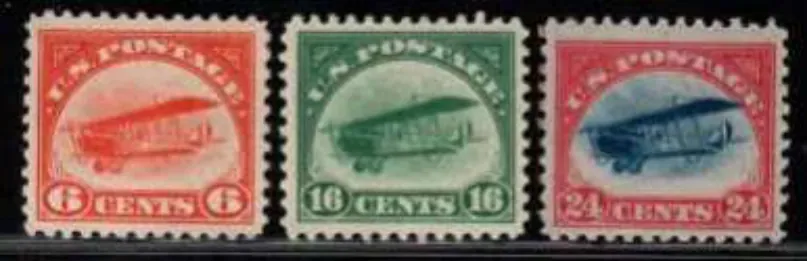
The 1918 Curtiss Jenny Air Mail Stamps were a set of three Airmail postage stamps issued by the United States in 1918.