 EAA Chapter 430
A Jacket with a Story
Open the PDF at page 3 See the whole February 2024 issue
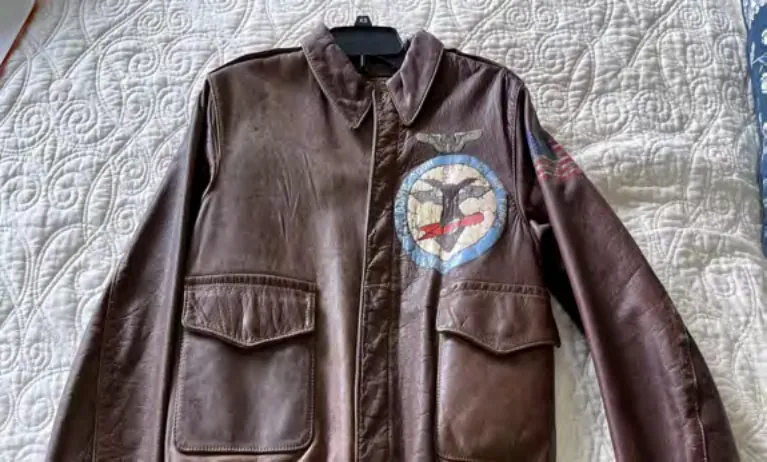
Sometimes the greatest treasures are right in front of you. Such was the case for me, back in 1989 as I was meeting my girlfriend Donna for our third date. Although I was more interested in the 5-foot tall green eyed girl I’d eventually marry, I must admit the neat bomber jacket she had on caught my eye as well. As a pilot wannabe, anything aviation related scored points in my book. She was wearing what appeared to be an authentic looking WWII-era bomber jacket. “Nice jacket”, I said. “It looks really authentic!”
“What do you mean?”, asked Donna. “Well, it looks like a real WWII bomber jacket,” I said. She then politely told me it was an authentic WWII jacket. “Okay, I gotta see this!”. Nothing like asking your girlfriend to take some of her clothes off on the third date.
As it turns out, Donna’s grandfather, Chuck, had read that bomber jackets were in style among the younger crowd, thanks in large part to the movie Top Gun which had come out two years prior. This motivated him to go up in the attic and find his jacket, which had been folded up in a box since the late 1940s. He then gave it to his granddaughter thinking it might be a “cool” thing for her to wear.
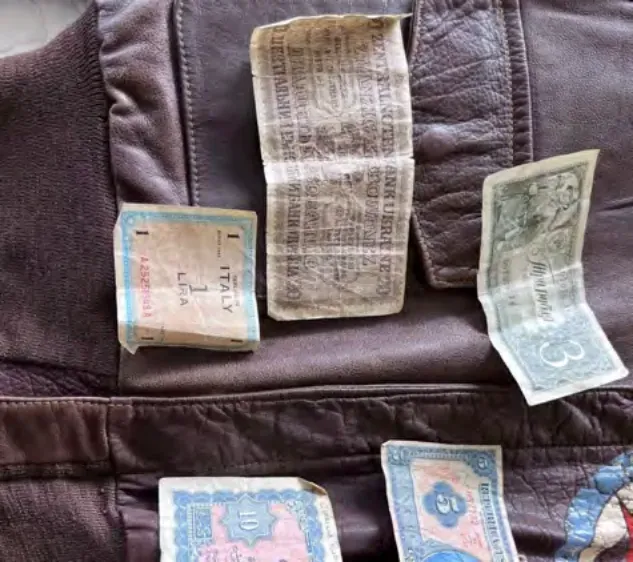
For a 45 year old leather jacket, it had held up extremely well, thanks to being undisturbed for all those years in the dry Colorado climate. On the left front side was the squadron patch for the 347th Bomb Squadron, 99th Group, 15th Air Force. On the right front side were 51 little bombs, one for each mission he had flown. On the back was a painting of a B-17 named Miss Betty Lou. Awesome! I couldn’t believe I was holding a piece of history like this in my hands. But it gets even better … I reached into the right pocket and discovered a Service Writing Tablet, the official name for a pocket-sized notebook. Within these pages of history were the full crew lineup, and a short narrative for each of the 51 missions he had flown as belly gunner on the B-17. What a find! In the left pocket I pulled out a small assortment of bills from various countries, and it turns out these were kept by each crew member in case they were shot down and needed to bribe their way to safety.
At this point in our relationship I had not met any of Donna’s family, but I could not wait to talk to Chuck about his experiences during WWII. I finally got to meet him several weeks later when I was invited to a family dinner. I quickly discovered Chuck was typical of a veteran of his generation. Humble, thankful for what he had in life, and did not feel the need or even desire to talk about his experiences during the war. In fact, the only thing he had ever told Donna about the war was the fact he used to trade his drink and cigarette rations with his fellow crew members for more eggs!
It turns out Charles “Chuck” Hudson was drafted in 1943 and volunteered for the Army Air Corps due to the extra pay he’d receive. Due to his small size (5’2”
and skinny as a rail) he was the natural pick of the crew to be the belly gunner, one of the most cramped and hazardous spots on the aircraft. For those of you not too familiar with the belt gunner’s ball turret, it is just under four feet across on the bottom of the aircraft, designed to help protect from fighters attacking from below. Unheated and non-armored, the gunner was forced to sit in a fetal position, and wore an oxygen mask and a heated suit to help protect from the sub zero temperatures found up at altitude.
Due to the lack of room, most turret gunners left their parachutes in the main cabin and hoped for the best.
Two joysticks pivoted the turret - one for left and right and the other for up and down. Two foot pedals were used as well - one to control the gunsight and one to control the intercom. And the punch came from two loud and powerful light-barrel Browning AN/M2 .50 caliber machine guns. After some quick training in Hunter Field, Georgia, now Sgt. Hudson was sent to Foggia, Italy to join the 347th in the early part of 1944. As luck would have it, the crew drew straws to determine who would name the B-17 assigned to them, and Chuck won the drawing. He named the aircraft “Miss Betty Lou” in honor of his sweetheart waiting for him back home. More on Betty Lou later. Over the next four months, Chuck flew 51 missions, mostly out of Foggia, Italy. He was also one of the first crews to fly out of Potlava, Ukraine (Russia) as part of the shuttle bombing crews as they were known. He flew as belly gunner on every mission, and also took over as waist gunner on his last mission when one of the waist gunners was tending to the tail gunner who was wounded in action. His crew bombed Nazi targets throughout the European theater, including Monte Cassino, Regensburg, Rome, Budapest, Belgrade, Ploesti, and several others.
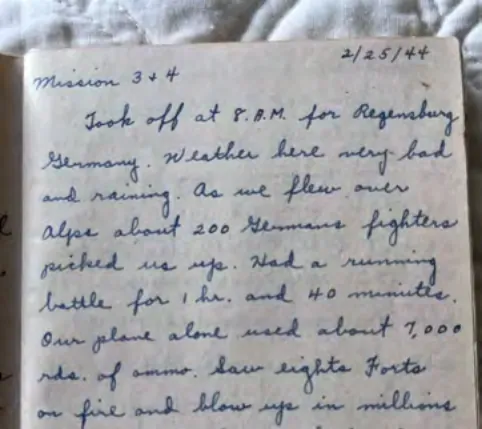
Here are a few snapshots from the diary:
Mission # 3 and 4 2/25/44 Took off at 8 am for Regensburg, Germany. Weather here very bad and raining. As we flew over Alps about 200 German fighters picked us up. Had a running battle for 1 hour and 40 minutes. Our plane alone used about 7,000 rounds of ammo. Saw eight Forts on fire and blow up in millions of pieces. About ten chutes in air at once. Also saw five fighters go down in flames and burn on sides of mountains. When we went over target our nose, top and tail guns were out. One 20 MM hit our nose and bombardier got Purple Heart.
Mission# 10 3/17/44 Took off at 9:29 for Fischamend Market, Austria to bomb ME 110 aircraft factory. Used new 18 plane formation. Weather here good but haze over target. P-47 escort and got attacked by MEs. I shot one down 7 o’clock low. Some planes dropped bombs because were low on gas. No flak. Brought bombs home. Waist gunner shot up stabilizer. Landed at 3:30pm.
Mission# 39 5/18/44 Took off at 7:40 for Ploesti, Rumania. P-51 escort never came. Few fighters. Weather awful and turned back. Planes everywhere. Over Yugoslavia they threw a heavy accurate barrage of flak and planes were everywhere. Four direct bursts of flak hit “Daisy Mae” and tore the whole nose off up to the bomb bay, and it blew in millions of pieces. Two chutes open and one all ripped up and blew open after explosion. Tail section hit mountain. Landed at 12:30.
All in all, Chuck flew 51 missions and received at least six Air Medals. Now back to Betty Lou. As his service came to an end in Europe, Chuck faithfully shipped his parachute back to her so she could make a wedding dress, which was a common practice at the time due to the shortage of fabric back home. Unfortunately, Betty Lou had eyes for someone else by then, and she used the silk to make a dress to marry her new love. But all was not lost. As luck would have it, a mistake was made as to where he was ordered to out- process after the war.
Although he told his XO he wanted to out-process from Bolling Field (near his hometown in Maryland), his XO thought he said “Boeing Field”. By the time the mistake had been discovered the orders had already been cut, so Chuck was instructed to take the long train ride to Boeing Field, out-process, then take the train back to Maryland.
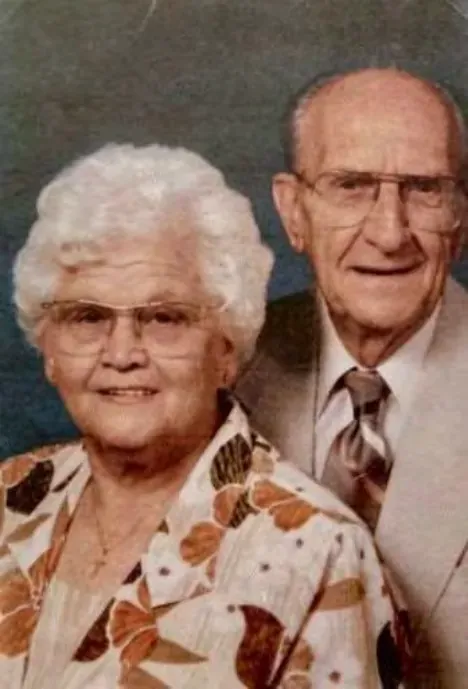
As he made his way to Seattle, his train stopped near Denver for a several hour break, and a local gentleman asked a few of the servicemen if they’d like to come over and have dinner. Never one to pass up a good (or free!) meal, Chuck was one of the lucky three men who accepted the invite. During dinner, he just happened to meet a young lady named Isabelle, one of the daughters of the gentleman who had invited him over for dinner. I’m happy to report it was love at first sight and they married soon thereafter and remained happily married until Chuck’s passing in 1999.