 EAA Chapter 430
VMC/IMC Club - August Excerpt: Traffic Advisory Procedures at Non-Towered Airports
Open the PDF at page 11 See the whole August 2026 issue
Our monthly EAA Chapter 430 VMC/IMC Club meetings continue to be well attended and highly enjoyable, but learning and being a better pilot is the key benefit of these sessions.
Harry Cook, our chapter VMC/IMC Club director, puts considerable thought and effort into the content and his engaging presentations. Please find below, some recent excerpts that will hopefully serve to extend the reach and value of the material Harry compiles and brings to our attention each month.
Thanks Harry!
— Editor
Traffic Advisory Procedures at Non-Towered Airports
Collisions continue at a steady rate
Midair collisions have continued at a steady rate in the past 20 years, statistics show. Most years such accidents number in the teens, but occasionally the number reaches the lower to mid-20s.
The definition of the collision problem has expanded recently to include runway incursions, and has led to new safety efforts. ASF has placed a runway-incursion training program on AOPA Online. Among the foundation’s publications is the Collision Avoidance: Strategies and Tactics Safety Advisor that can be viewed or ordered on ASF’s Web site.
Approach and landing — a dangerous time
ASF data indicate that 45 percent of collisions occur in the traffic pattern, and of these, two-thirds occur during approach and landing when aircraft are on final or over the runway. Confusion about the location of aircraft and their landing order often begins earlier in the pattern. As you might expect, operations at non-towered airports offer the greatest risk.
⦁ Mid-air collisions generally occur during daylight hours—56 percent occur in the afternoon, 32 percent occur in the morning, and 2 percent occur at night, dusk, or dawn.
⦁ Most mid-air collisions occur under good visibility.
⦁ A mid-air collision is most likely to occur between two aircraft going in the same direction.
⦁ The majority of pilots involved in mid-air collisions are not on a flight plan.
⦁ Nearly all accidents occur at or near uncontrolled airports and at altitudes below 1,000 feet.
⦁ Pilots of all experience levels can be involved in mid-air collisions.
Available Resources
FAR 91.126 Airplane Flying Handbook Advisory Circular 90-66C – Non-Towered Airport Flight Operations
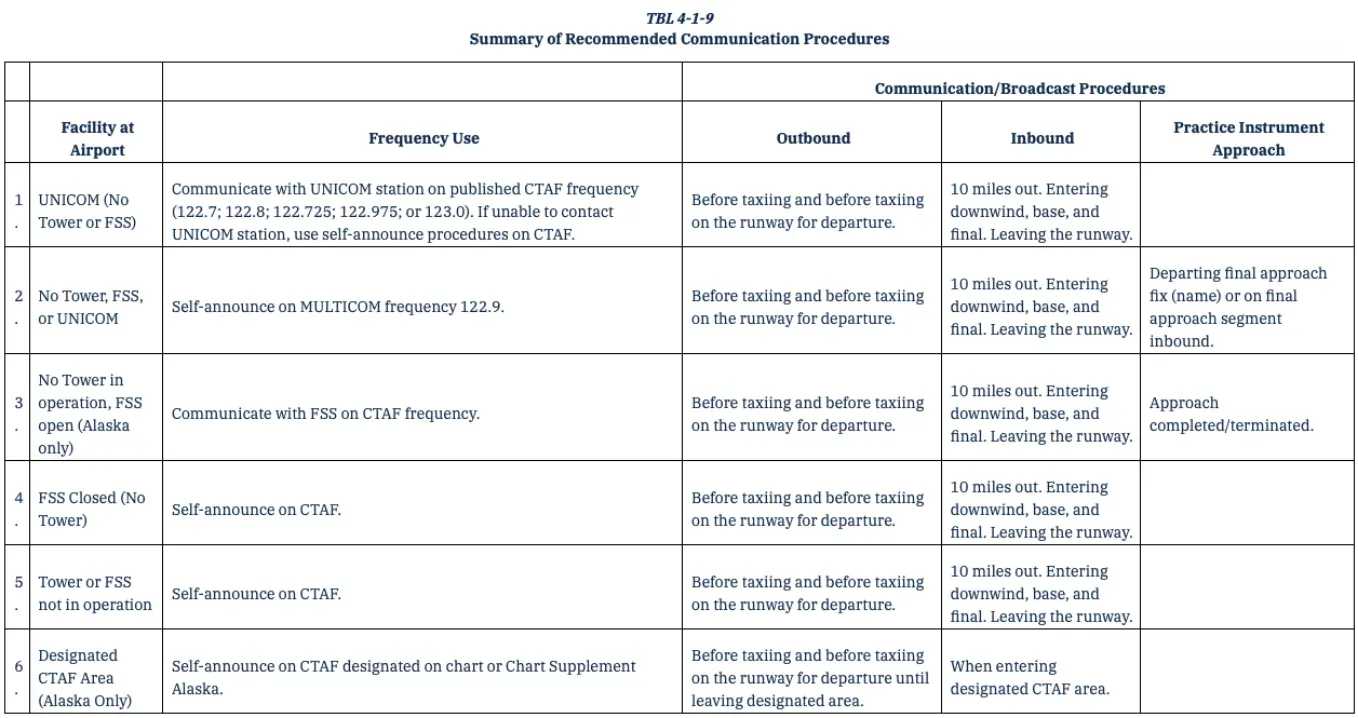
AIM Chapter 4-1-9, Traffic Advisory Practices at Airports Without Control Towers
The following are some important procedures that all pilots should follow when flying in a traffic pattern or in the vicinity of an airport.
-
Tune and verify radio frequencies before entering the airport traffic area.
-
Monitor the correct Common Traffic Advisory Frequency (CTAF).
-
Report position 10 miles out and listen for reports from other inbound traffic.
-
At a non-towered airport, report entering downwind, turning downwind to base, and base to final.
-
Descend to traffic pattern altitude before entering the pattern.
-
Maintain a constant visual scan for other aircraft.
-
Be aware that there may be aircraft in the pattern without radios.
-
Use exterior lights to improve the chances of being seen.
9.5 Prior to Takeoff, VFR or IFR, Traffic Verification, and Communications.
Communication at non-towered airports or at airports where the control tower is closed is critical. Pilots are reminded that in these cases surveillance of other traffic by the air traffic controller is removed from the safety picture; hence, you are assuming this role. All traffic, whether IFR or VFR, should, at a minimum, monitor the CTAF. For departures a minimum of 10 minutes prior to taxi and arrivals a minimum of 10 miles out from the airport, you should broadcast your intentions. The importance of air-to-air communications cannot be overemphasized. Failure to follow this communication protocol has contributed to near midair collisions (NMAC), and as such could be considered careless and reckless operation of an aircraft.
REFERENCE — AIM 4-1-9 g. Self-Announce Position and/or Intentions 1. General. Self-announce is a procedure whereby pilots broadcast their position or intended flight activity or ground operation on the designated CTAF. This procedure is used primarily at airports which do not have an FSS on the airport. The self-announce procedure should also be used if a pilot is unable to communicate with the FSS on the designated CTAF. Pilots stating, “Traffic in the area, please advise” is not a recognized Self-Announce Position and/or Intention phrase and should not be used under any condition.
-
If an airport has a tower and it is temporarily closed, or operated on a part-time basis and there is no FSS on the airport or the FSS is closed, use the CTAF to self-announce your position or intentions.
-
Where there is no tower, FSS, or UNICOM station on the airport, use MULTICOM frequency 122.9 for self-announce procedures. Such airports will be identified in appropriate aeronautical information publications.
-
Straight -in Landings. The FAA discourages VFR straight -in approaches to landings due to the increased risk of a mid-air collision. However, if a pilot chooses to execute a straight-in approach for landing without entering the airport traffic pattern, the pilot should self-announce their position on the designated CTAF approximately 8 to 10 miles from the airport and coordinate their straight-in approach and landing with other airport traffic. Pilots executing a straight-in approach (IFR or VFR) do not have priority over other aircraft in the traffic pattern, and must comply with the provisions of 14 CFR 91.113 (g), Right-of-way rules.
-
Traffic Pattern Operations. All traffic within a 10 -mile radius of a non -towered airport or a part-time-towered airport when the control tower is not operating, should monitor and communicate on the designated CTAF when entering the traffic pattern. Pilots operating in the traffic pattern or on a straight-in approach must be alert at all times to other aircraft in the pattern, or conducting straight-in approaches, and communicate their position to avoid a possible traffic conflict. In the airport traffic pattern and while on straight-in approaches to a runway, effective communication and a pilot’s responsibility to see-and-avoid are essential mitigations to avoid a possible midair collision. In addition, following established traffic pattern procedures eliminates excessive maneuvering at low altitudes, reducing the risk of loss of aircraft control.
REFERENCE — FAA Advisory Circular (AC) 90-66, Non-Towered Airport Flight Operations.