 EAA Chapter 430
Getting to Know You
Open the PDF at page 5 See the whole April 2019 issue
Harry Cook, Treasurer
Like many aviators my age, I grew up watching “Sky King” on TV. That show and movies like “The Flying Leathernecks” and “Strategic Air Command” made lasting impressions. John Wayne and Jimmy Stewart, among others, became my aviation movie heroes. For as long as I can remember I was always enamored with airplanes and the prospect of flying them. I grew up on a small lake in up-state New York which served as a base of operations for four float planes. I spent hours watching them take off and land, imagining myself at the controls. I read about airplanes, built model planes, flew (or tried to fly) control line models and, I’m sure, drove my parents nuts, talking endlessly about airplanes. In later years I came to find out my parents were not too thrilled with my growing enthusiasm for flying. My Grandmother, on the other hand, encouraged me to pursue my dreams. In the late 1950’s my Grandmother took my younger brother and me to an airshow outside Rochester, NY. At the show, she bought us a ride in a Stinson. I can’t remember the model, I just remember it was a Stinson. It was my first ride in an airplane and if I wasn’t completely hooked on aviation before the flight, I certainly was afterwards.
From that moment on I knew I wanted to be a pilot. In 1962, while still in junior high school, I actually wrote to United Airlines to ask them what the requirements were to become an airline pilot. To my utter amazement they wrote back. Their letter listed the criteria they were looking for. I needed to graduate from high school, go to college and get a degree, preferably in a technical discipline, and in the mean time get as much flying experience as I could. They explained that the majority of their pilots came to them with a great deal of experience, mostly from the military. This letter served as a guide for the next several years of my life.
In the summer of 1962 my family moved to northern New Jersey. My new school had a curriculum for college bound students so, following United’s advice, I got on that track and did my best to stay on it. As soon as I reached driving age (17 in New Jersey) I got my driver’s license and immediately started driving around looking for airports. I found a great little airport in East Hanover, NJ and on April 15th, 1967 I had my first lesson. I soloed a couple months later, on July 8th, 1967.
Continuing to follow United’s advice, I entered Newark College of Engineering in the fall of 1967. It fit the requirement for a technical discipline and had the added bonus of hosting an Air Force ROTC program. Between studying and working part time to help pay for college and flying lessons it took almost a year, but on June 21st, 1968 I received my private pilot’s certificate. I graduated from college and was commissioned a Second Lieutenant in the US Air Force on June 3rd, 1971. About five weeks later I reported to Moody AFB, Georgia for pilot training.
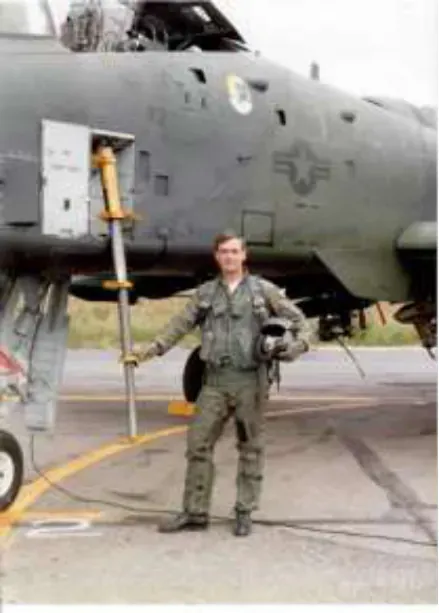
The Air Force turned out to be a good fit for me. I spent the next 20 years as an Air Force pilot. I have flying time in the T-37, T-38, T-33, F-4E, OV-10A and A-10A. While in the Air Force I continued to fly GA aircraft in flying clubs at nearly every base I was stationed. I received my civilian commercial and instructor certificates while still on active duty. At my last duty station, in Alaska, I bought my first plane, a 1952 Cessna C-170B. I retired from the Air Force in 1991 and remained in Alaska until 2015.
Upon leaving the Air Force I went back to school to earn an Airframe and Powerplant certificate. After a short stint as a university instructor I returned to flying professionally flying Piper Navajos, and Beechcraft Be -99s for a Part 135 operation, Frontier Flying Service, in Interior Alaska. I continued my commercial aviation experience with a Part 121 operation, Everts Air Cargo, flying cargo in DC-6’s. Everts also had a small Part 135 operation where I flew Piper Navajos and Cessna Caravans. I remained with Everts as their general manager until my second retirement in 2008. (continued on following page)
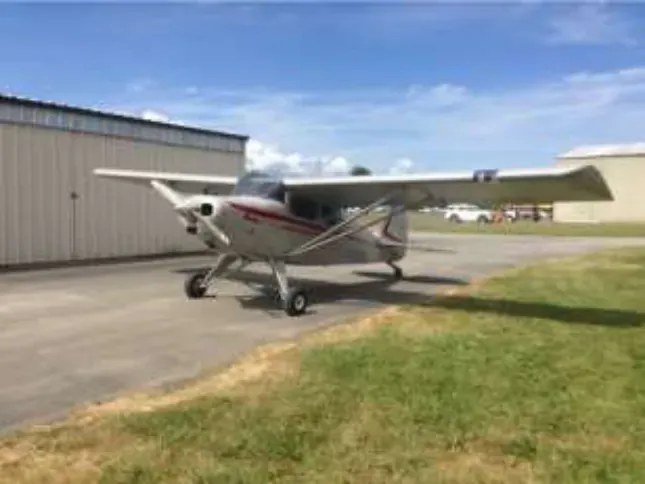
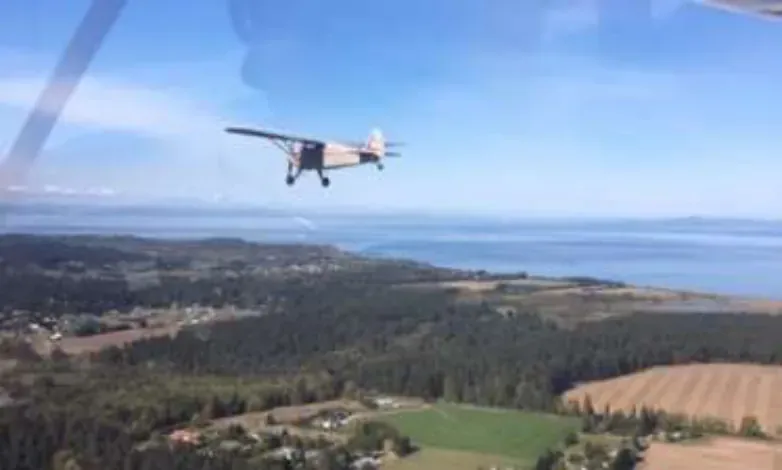
After this second retirement I began working as a part time freelance A&P (working mostly on my own aircraft.) In addition to the C-170B I have also owned and refurbished a 1966 Cherokee 6, a 1976 Cessna C-172M and, most recently, a 1956 Piper PA-22/20.
I have been a pilot over 50 years and an A&P with Inspection Authority for over 25 years. I have over 7000 hours of flying time.
And now … the rest of the story: Harry’s story continues after an interview with the newsletter editor.
During his time at Newark College of Engineering, Harry was a cadet in the Air Force ROTC program. It was in this program he received his first “jet ride” in a T-33. From that moment on he knew he was on the right track. His goal of becoming a fighter pilot was beginning to materialize. He was commissioned as a Second Lieutenant upon graduation from college in 1971 and received his pilot training at Moody AB in Georgia. Training consisted of three phases. First was a short flight indoctrination program in the T-41, a slightly modified Cessna C-172. This was followed by six months training in the Cessna T-37 basic jet trainer and then another six months in the T-38 advanced jet trainer.
His first assignment was as a flight instructor in the T-37 at Sheppard AFB in Wichita Falls, Texas. Before moving to Texas, he married Kathie, who he had met in his senior year of college at a New Year’s Eve party. While in Texas, not only did Kathie continue with her education, they started their family, a daughter named Hillary. They were stationed in Texas for the next three years.
When it came time for Harry’s next assignment pilots were returning from Vietnam, filling most of the pilot positions. The Air Force offered him an assignment as a civil engineer. However, with this assignment came the possibility of never returning to a position as a pilot. To avoid this, he applied and received a special duty assignment, choosing to become a recruiting officer, which meant he could eventually return to flying. Harry and Kathie spent the next three years stationed at Hanscom Field in Massachusetts. During this assignment their second child, Christopher, arrived.
After recruiting, his next flying assignment was in the F-4E Phantom, stationed at Ramstein AB Germany. The training for that assignment sent him to a three month tactical school in New Mexico flying the AT-38 and then to a six month school at Homestead AFB, Florida for the F-4 training. After three years at Ramstein he transitioned to the OV-10 (Bronco). This was an airborne Forward Air Controller assignment and was located at Sembach AB, also in Germany. After two years, he went back at Ram-stein for a two year desk job. Looking for a way to get back in the air, he joined a German soaring club, learning to fly a glider.
One of his more interesting missions in the Air Force was flying an F-4 (one in a flight of six planes) from Germany to Florida non-stop with air-to-air refueling by 6 tankers. The trip took eleven hours and 20 minutes. Another time, when he was at Sembach AB, he flew another transoceanic flight in the OV-10. This trip took him hop-scotching through several European countries and across the North Atlantic to deliver the plane back to the US. (continued on following page)
After seven years in Germany, he was given an A-10 assignment with a choice of going to England, Louisiana or Alaska. He and Kathie thought Alaska sounded the most interesting. After training at Davis-Monthan AFB the family drove to Fairbanks, Alaska and were stationed at Eielson AFB. Kathie taught first grade in Fairbanks and ultimately became a principal at the school. After retiring from the Air Force, Harry was an instructor for three years at the University of Alaska.
He then flew commercially in a Piper Navajo Chieftain for four years. He said, “I probably had more hours flying Chieftains than I did flying planes in my military career.” Following that job he flew DC-6s with Everts Air Cargo for many years before deciding it was time to move back to the “Lower 48.”
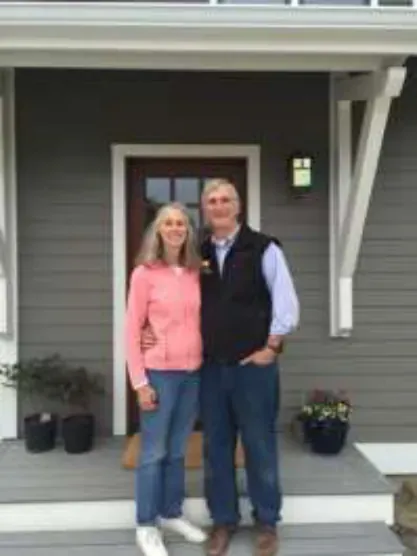
After Kathie read The Wildwater Walking Club by Claire Cook, (a story about a road trip to Seattle for a lavender festival) they spent time exploring the Pacific Northwest before settling in Sequim. They bought property, built a home and Harry joined EAA Chapter 430 where he has served as treasurer for the past two years. He flew Young Eagles when he was a member of EAA Chapter 1129 in Fairbanks and has been a member of EAA since 1976. He has been to Oshkosh EAA AirVenture three times.
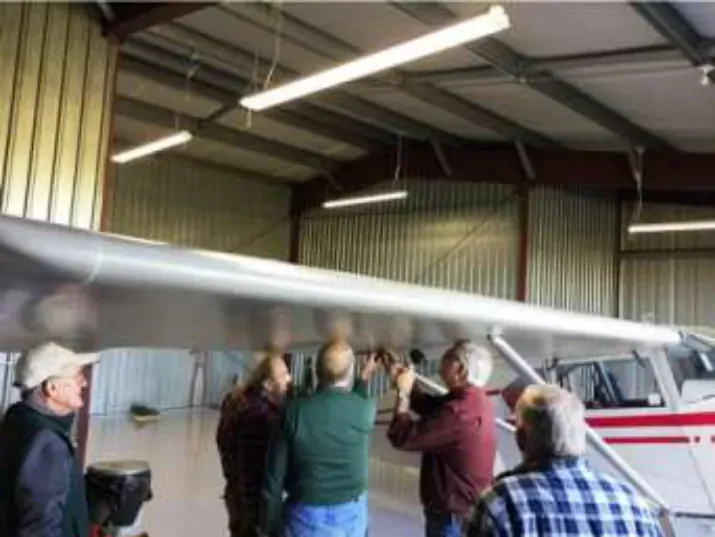
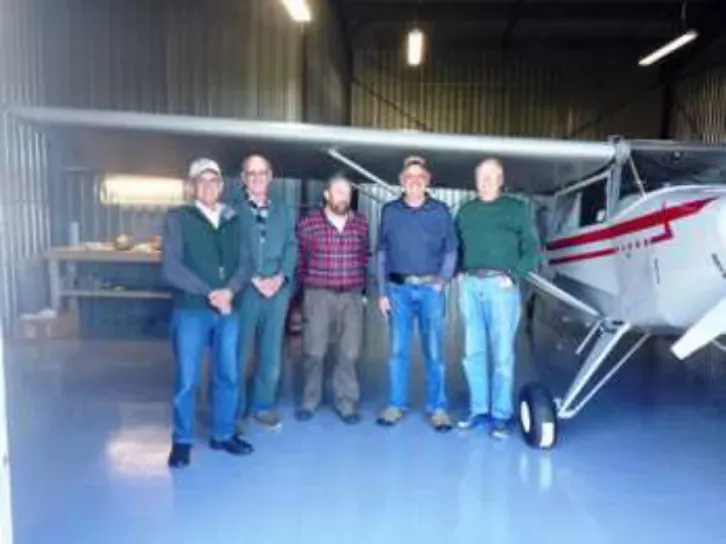
He recently completed restoring a Piper Pacer and is considering building a plane “from scratch.”
EAA members helping install the wings on the Piper Pacer after moving it from his workshop to the hangar He enjoys woodworking projects and is presently building a kayak. He and Kathie enjoy their motor home, traveling to California frequently to spend time with their 3 grandchildren.